
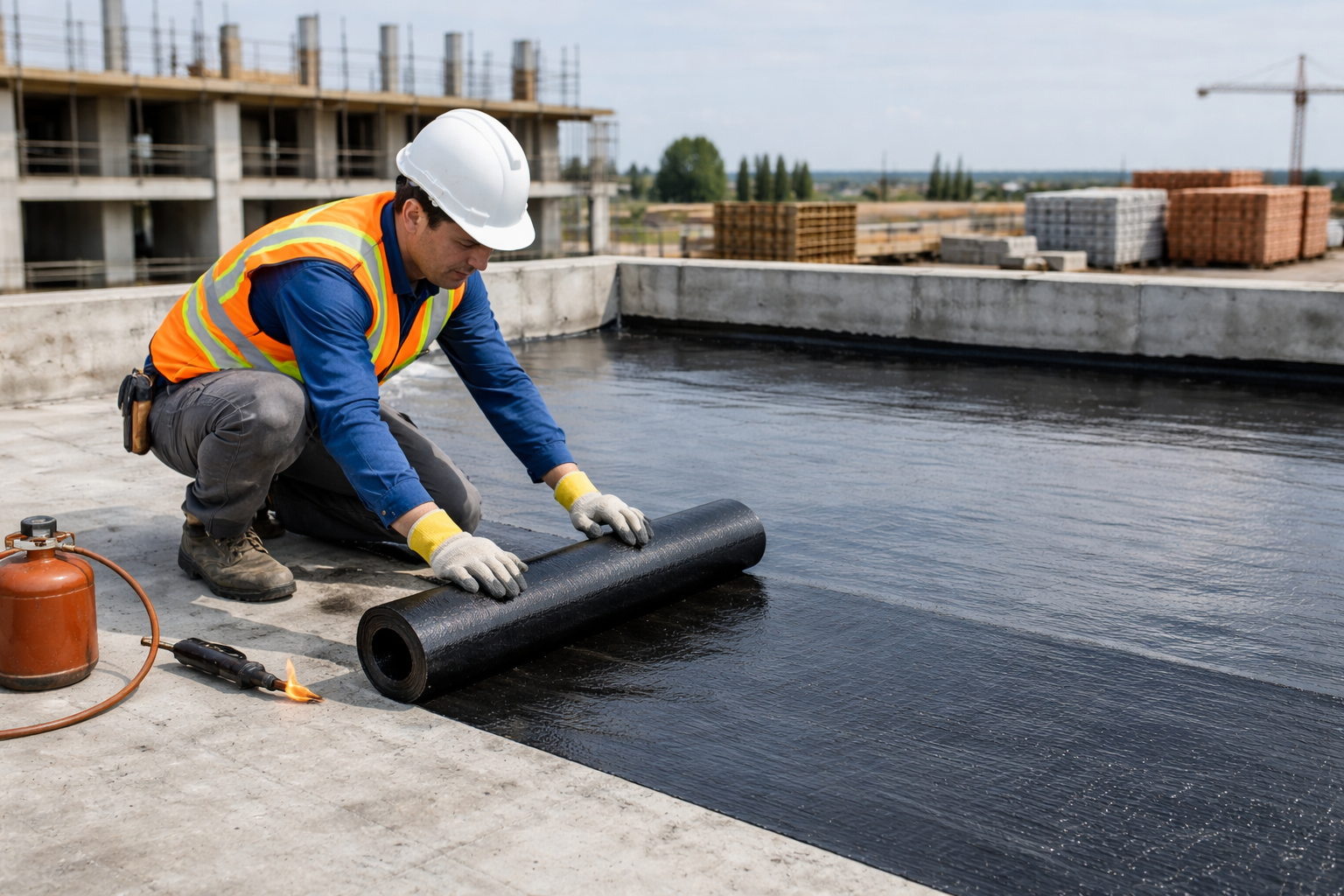
A waterproofing membrane is a thin, continuous barrier layer — made from bitumen, polymer, HDPE, cementitious compound, or polyurethane — applied to a concrete or masonry structure to prevent water and moisture from penetrating through the surface into the structural substrate.
In Singapore construction, waterproofing membranes are specified across 6 structural zones: basement slabs and walls, roof slabs and podium decks, wet area floors (bathrooms and kitchens), retaining walls, underground car parks, and foundation elements. Singapore’s tropical climate — annual rainfall of 2,340mm, ambient relative humidity of 70–90%, and daily temperature cycling between 23°C and 34°C — makes waterproofing membrane specification a structural necessity, not an optional upgrade.
Waterproofing costs at the construction stage average 3% of a building’s total construction value. Remedial waterproofing after structural water damage — including membrane removal, surface preparation, re-application, screed replacement, and affected floor finish reinstatement — costs 5–20x more than the original waterproofing specification.
What Is a Waterproofing Membrane?
A waterproofing membrane is a watertight material layer bonded or applied to a structural surface — concrete, masonry, screed, or substrate board — to prevent water migration from the wet side of the structure to the dry side, protecting the structural concrete, embedded reinforcement, and interior spaces from moisture damage.
A waterproofing membrane performs 4 distinct protective functions in a building structure:
- Water exclusion: blocks liquid water from passing through the membrane layer under hydrostatic pressure — the primary function; measured in MPa water pressure resistance over a defined test period (e.g. impervious at 0.3 MPa for 120 minutes under GB/T35467-2017)
- Moisture vapour control: limits water vapour transmission through the structure from high-humidity zones (soil, water table, wet rooms) to dry zones (interiors, insulation layers, finishes); critical in below-grade applications where ground moisture exerts continuous vapour pressure
- Reinforcement corrosion protection: prevents chloride ions, sulphates, and dissolved salts in groundwater from reaching embedded steel reinforcement bars — the primary mechanism of concrete structural degradation in Singapore’s coastal and high-humidity environment; concrete maintains a pH above 12.5 that passivates steel, but water ingress lowers pH and initiates corrosion
- Crack bridging: flexible membrane types (HDPE, polyurethane, SBS bitumen) accommodate minor structural movement and hairline concrete cracking — typically 0.2mm–1.0mm crack widths — without losing watertight integrity; rigid types (cementitious coatings) tolerate minimal crack movement and are suited to static structures
Key technical terms used in waterproofing membrane specification:
- Positive-side waterproofing: membrane applied to the surface facing the water source — the outer face of a basement wall, the top face of a roof slab; water pressure pushes the membrane against the structure, improving adhesion under load
- Negative-side waterproofing: membrane applied to the surface away from the water source — the interior face of a basement wall; used when exterior access is not possible; water pressure acts to pull the membrane away from the substrate, requiring mechanical or chemical bonding
- Blind-side waterproofing: membrane applied before the concrete structural element is poured against it — used in urban construction where no excavation perimeter access exists; the membrane bonds to the freshly poured concrete directly
- Hydrostatic pressure: water pressure exerted by a column of water on a submerged or below-grade surface — 1 metre of water depth exerts approximately 0.01 MPa; a 3-metre basement depth exerts 0.03 MPa; deep basement structures (6m–15m) require membranes rated at 0.3 MPa+
How Does a Waterproofing Membrane Work?
A waterproofing membrane works by creating a continuous, impermeable barrier layer that is fully bonded to the structural substrate — blocking all capillary water paths, surface cracks, construction joints, and interface gaps through which liquid water or water vapour migrates under pressure.
The waterproofing mechanism operates through 3 physical principles depending on membrane type:
1. Physical Barrier (Sheet and Self-Adhesive Membranes)
Sheet membranes — including HDPE, modified bitumen, and PVC — work by interposing a physically impermeable material layer between the water source and the structure. Water cannot penetrate the membrane material itself. The membrane’s watertight integrity depends entirely on 3 factors: the absence of pinholes or tears in the sheet, the integrity of the overlap joints (minimum 60mm longitudinal, 100mm transverse), and the continuous bond between the membrane and the substrate at all interfaces.
- Cross-laminated HDPE mechanism: multiple layers of high-density polyethylene film laminated in alternating directions — bidirectional reinforcement prevents tear propagation; the membrane cannot be pierced by construction loads without a full-thickness failure that is visible and repairable before concrete pour or backfill
- Self-adhesive bonding mechanism: polymer-modified rubber bitumen adhesive layer activates under pressure — pressing the membrane onto the substrate displaces air and creates a continuous adhesive bond across the full membrane area; wet-bonding technology allows application to damp concrete (surface moisture accepted) without losing bond strength
- Overlap joint integrity: the most critical construction detail in any sheet membrane system; inadequate overlap, contaminated overlap surfaces, or lifted overlap edges are the primary entry points for water in all installed sheet membrane systems
2. Chemical Crystallisation (Cementitious Membranes)
Cementitious waterproofing membranes work by a chemical crystallisation mechanism — the cementitious coating reacts with water and concrete to form insoluble calcium silicate hydrate crystals that fill the capillary pores, microcracks, and voids in the concrete surface, blocking all water migration paths through the material.
- Reactive chemicals: Portland cement + silica sand + active chemicals (silicates, aluminates) form crystals in the presence of water and cement hydration products; crystals grow to fill pores from 0.001mm to 0.5mm in diameter
- Self-sealing property: crystallisation continues as long as water and cement remain in contact — a cementitious membrane continues to self-seal new microcracks up to 0.4mm wide over the structure’s service life
- Limitation: cementitious membranes tolerate minimal structural movement — crack widths above 0.4mm break the crystal matrix; not suitable for structures with dynamic loading, thermal cycling above 15°C differential, or flexible joints
3. Elastic Film Formation (Liquid-Applied Membranes)
Liquid-applied membranes — polyurethane (PU), acrylic, and bituminous emulsion — work by curing into a seamless elastic film across the applied surface. The liquid state allows the product to penetrate all surface irregularities, hairline cracks, and substrate joints before curing, producing a continuous membrane with no physical seams or overlap joints.
- Polyurethane curing: single-component PU reacts with atmospheric moisture to form a cross-linked polyurethane elastomer at 1.0mm–2.5mm dry film thickness; elongation at break of 300–600% bridges substrate movement and crack formation after curing
- Acrylic curing: water-based acrylic polymer dispersions cure by evaporation and coalescence into a flexible film; elongation at break 100–200%; vapour-permeable — allows moisture vapour to escape through the membrane while blocking liquid water
- Seamless coverage: liquid-applied membranes eliminate the joint-integrity risk of sheet membranes entirely; the primary quality control variable is achieving consistent wet film thickness (controlled by application rate per sqm) across the full surface without pinholes or holidays
Why Is Waterproofing Membrane Critical in Singapore’s Climate?
Singapore’s tropical climate imposes 4 simultaneous waterproofing stresses on every building structure — continuous high rainfall, sustained high humidity, daily thermal cycling, and groundwater pressure — making waterproofing membrane specification critical for structural durability and long-term building performance.
- Rainfall intensity (2,340mm annually): Singapore receives an average of 2,340mm of rain per year — more than 3x the annual rainfall of London (600mm); tropical convective storms deliver 50–100mm of rainfall per hour during peak events; roof membranes, balconies, and flat slab structures face extreme ponding loads that test membrane impermeability at positive water pressure
- Sustained high humidity (70–90% RH): Singapore’s ambient relative humidity of 70–90% means that concrete structures are in continuous contact with airborne moisture; without waterproofing, capillary absorption draws moisture into concrete continuously — accelerating carbonation, chloride ingress, and embedded steel corrosion in coastal locations
- Daily thermal cycling (23°C–34°C): the daily temperature differential of 10°C–12°C causes concrete roof slabs and external walls to expand and contract by 0.5mm–1.5mm per linear metre daily; rigid, inflexible waterproofing coatings crack under this repeated thermal movement; flexible sheet membranes and elastic liquid-applied systems are required for all externally exposed Singapore structures
- Groundwater table and hydrostatic pressure: Singapore’s urban island geology maintains a groundwater table at 1.0m–3.5m below ground level in most districts; any below-grade structure — basements, lift pits, underground car parks, MRT-related construction — faces continuous hydrostatic pressure from the surrounding water table; below-grade membranes rated at 0.3 MPa+ are required for all structures below the water table.
In Singapore construction, BCA (Building and Construction Authority) requires waterproofing for all wet areas in residential buildings under CP 82:2016. For below-grade structures, SS EN 1992 and structural engineer specifications govern membrane selection. Waterproofing that meets the 10-year warranty requirement under Singapore’s Building Maintenance and Strata Management Act (BMSMA) must be specified by a Registered Professional Engineer (RPE) for structural elements.
What Are the Types of Waterproofing Membranes?
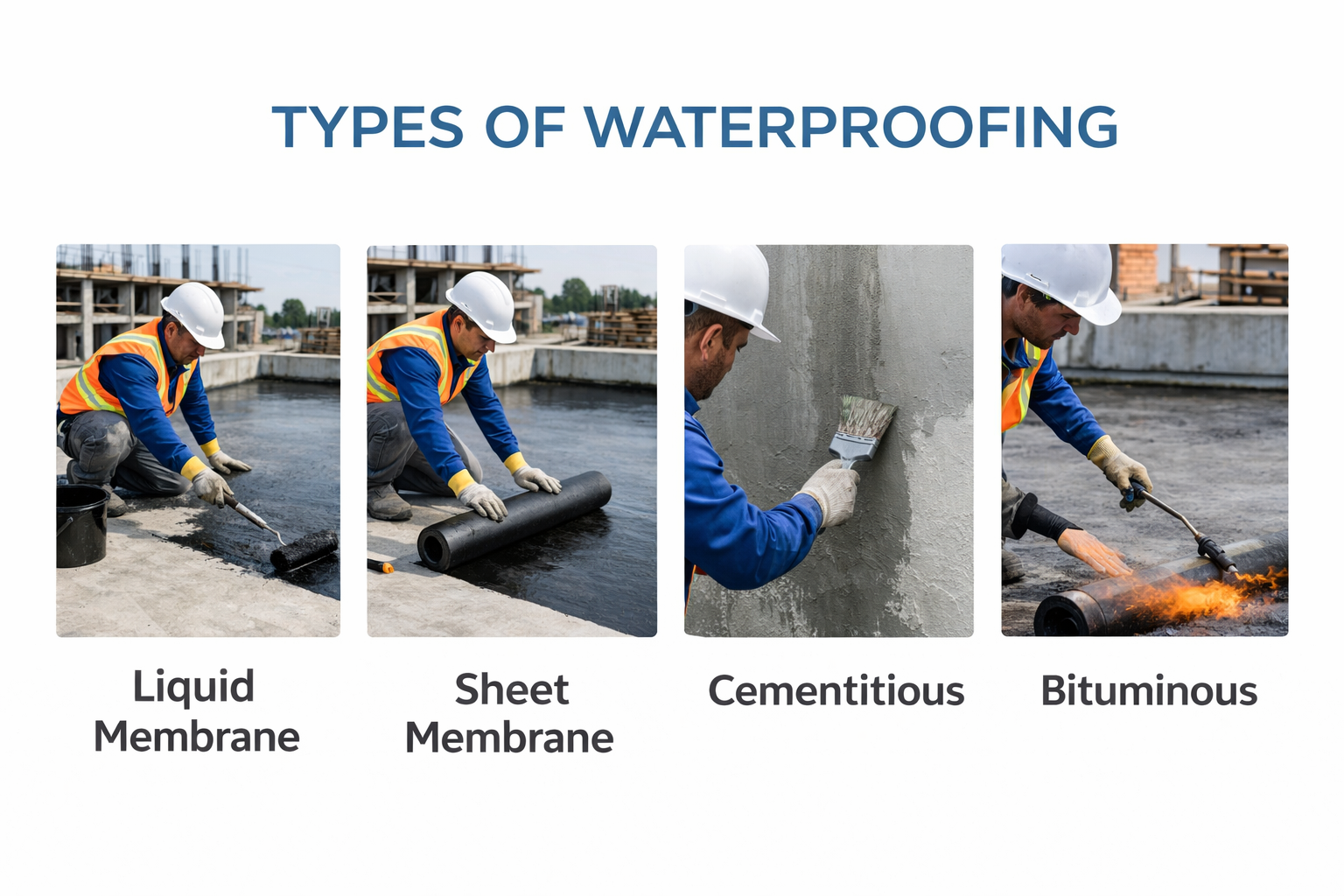
There are 5 main types of waterproofing membranes used in Singapore construction — self-adhesive HDPE sheet membrane, modified bitumen (torch-on) sheet membrane, cementitious membrane, polyurethane (PU) liquid-applied membrane, and PVC/TPO thermoplastic sheet membrane — each classified by material composition, application method, and structural zone suitability.
1. Self-Adhesive HDPE Waterproofing Membrane
Self-adhesive HDPE waterproofing membrane combines a cross-laminated high-density polyethylene (HDPE) film with a pressure-sensitive polymer-modified rubber bitumen adhesive layer — creating a physically impermeable, permanently bonded barrier on concrete structures without requiring torch application or heat welding.
- Composition: cross-laminated HDPE carrier film (1.0mm or 1.5mm total thickness) + polymer-modified rubber bitumen adhesive + release liner; the cross-lamination of HDPE layers in alternating directions produces bidirectional tear resistance — tears cannot propagate in a single direction as in unidirectional films
- Water pressure resistance: impervious under 0.3 MPa water pressure for 120 minutes (GB/T35467-2017 Type II); suitable for below-grade structures at depths up to 30 metres
- Low-temperature flexibility: no cracking at −20°C — maintains membrane integrity during extreme cold (relevant for cold storage facilities in Singapore industrial parks)
- Bond strength: peeling strength of 1.5 N/mm with cement mortar; 90% tensile retention rate after water immersion — the adhesive layer maintains full bond strength under sustained water contact
- Heat resistance: no flowing or slipping at 70°C — critical for Singapore roof slab applications where membrane surface temperatures reach 55°C–70°C under direct solar radiation
- Wet-bonding capability: applies to damp concrete substrates — surface moisture does not prevent adhesion; eliminates the mandatory drying period required for torch-on systems
- Application: peel-and-stick installation; overlap joints 60mm longitudinal and 100mm transverse; no open flame required; no specialised torch equipment; faster installation than torch-on on the same area
- Available sizes: 1m × 20m rolls in 1.0mm and 1.5mm thickness; 60mm overlap markings pre-printed on the roll for controlled installation
- Primary applications: concrete foundations, basement slabs and walls, basement wet areas before screed, roof slabs, podium decks, retaining walls, and below-grade horizontal and vertical structures
Cemimax Asia’s self-adhesive waterproofing membrane (cemimaxasia.com) is a cross-laminated HDPE membrane combined with polymer-modified rubber bitumen adhesive — rated impervious at 0.3 MPa for 120 minutes, with 1.5 N/mm peel strength and heat resistance to 70°C. It is supplied in 1m × 20m rolls in 1.0mm and 1.5mm thickness for below-grade and horizontal structural applications in Singapore.
2. Modified Bitumen (Torch-On) Sheet Membrane
Modified bitumen torch-on membrane is a polymer-modified bitumen sheet — either SBS (Styrene-Butadiene-Styrene) elastomeric or APP (Atactic Polypropylene) plastomeric — heat-welded to the substrate using a propane torch to form a fully bonded waterproof layer.
- SBS modification: SBS polymer gives the bitumen elastomeric properties — the membrane stretches and recovers under structural movement; flexible at low temperatures; better fatigue resistance than unmodified bitumen; the dominant type for Singapore roof waterproofing
- APP modification: APP polymer gives the bitumen plastomeric properties — stiffer than SBS; better UV resistance; higher heat resistance (softening point 130°C vs 100°C for SBS); used in areas with intense solar radiation exposure
- Thickness: 3mm–5mm total; reinforced with non-woven polyester or fibreglass scrim carrier for dimensional stability and puncture resistance
- Application: propane torch heats the underside of the roll as it is unrolled onto the substrate, melting the bitumen to bond directly to the concrete; torch skill level directly affects bond quality — undertorching leaves adhesion voids; overtorching burns through the membrane
- Water pressure resistance: 0.3 MPa+ for standard 4mm SBS systems; suitable for all Singapore roof and below-grade applications
- Primary applications: flat roof waterproofing (the most widely used system in Singapore commercial construction), roof terraces, podium decks, balconies; also used in below-grade basement slabs
- Limitation: open flame requirement — not suitable for application near combustible materials, foam insulation, or in confined spaces without ventilation; requires certified torch operator
3. Cementitious Waterproofing Membrane
Cementitious waterproofing membrane is a cement-based coating composed of Portland cement, graded silica sand, and active chemical additives (polymer latex or crystalline agents), applied by brush or roller to form a rigid or semi-rigid waterproof layer bonded directly to the concrete substrate.
- 1K (one-component) system: pre-bagged powder mixed with water on site; simpler application; used for standard residential wet area waterproofing under tiles in bathrooms and kitchens
- 2K (two-component) system: powder component mixed with liquid polymer component; produces a more flexible, higher-performance membrane; used for balconies, water tanks, swimming pools, and structures with minor movement
- Applied thickness: 1.0mm–1.2mm dry film thickness in 2 coats; first coat applied and allowed to set (not full cure); second coat applied perpendicular to the first for full coverage
- Crack bridging: rigid cementitious systems bridge hairline cracks up to 0.2mm; 2K polymer-modified systems bridge cracks up to 0.4mm; not suitable for structures with movement joints or dynamic loading
- Positive and negative side: cementitious membranes are the only type suitable for negative-side waterproofing (applied to the dry interior face of a water-retaining wall) — particularly useful for water tanks and reservoirs where exterior access is not possible
- Anti-corrosion: maintains pH above 4.0 at the coating interface, protecting embedded steel reinforcement from the corrosion initiation that occurs when concrete pH drops below 9.0 through carbonation
- Primary applications: wet area floors in bathrooms and kitchens under tile finish; water tanks; swimming pools; below-tile balcony waterproofing; tunnel linings
- Limitation: not suitable for roof membranes or large externally exposed areas subject to thermal cycling above 15°C differential; brittle under structural movement
4. Polyurethane (PU) Liquid-Applied Membrane
Polyurethane liquid-applied membrane is a single or two-component polymer system applied by brush, roller, or spray that cures into a seamless, highly elastic waterproof film — the most flexible waterproofing membrane type, with elongation at break of 300–600%.
- Single-component (1K): moisture-curing PU; reacts with ambient humidity to form an elastomeric membrane; suitable for areas with consistent humidity (outdoor applications in Singapore qualify); pot life 2–4 hours; full cure 24–72 hours
- Two-component (2K): polyol + isocyanate components mixed at site; faster cure time (4–8 hours walkable); more consistent cure in low-humidity air-conditioned environments; used in Singapore indoor wet areas and below-slab applications
- Applied thickness: 1.0mm–2.5mm dry film thickness; applied in 2–3 coats; wet film thickness per coat controlled by application rate (typically 0.7–1.0 kg/m² per coat); holiday detection (spark testing) verifies pinhole-free coverage on critical applications
- Elongation at break: 300–600% — the highest elongation of any membrane type; bridges crack widths up to 2mm–3mm after curing without membrane failure
- Seamless coverage: no overlap joints or seams; continuous film across the full applied area including corners, drains, pipe penetrations, and irregular surfaces — eliminating the joint-failure risk of sheet membrane systems
- UV resistance: UV-stable formulations (aliphatic PU) maintain colour and surface integrity under Singapore’s direct sun exposure; aromatic PU yellows under UV but retains waterproofing performance — used in non-visible applications only
- Primary applications: balconies and terraces; planter boxes; roof waterproofing (especially where irregular geometry makes sheet installation difficult); car park decks; wet area floors under tile
5. PVC and TPO Thermoplastic Sheet Membrane
PVC (Polyvinyl Chloride) and TPO (Thermoplastic Polyolefin) membranes are single-ply thermoplastic sheet systems installed by hot-air welding at overlap seams — producing a mechanically strong, UV-resistant waterproof layer used primarily in large commercial roof applications.
- PVC composition: flexible PVC sheet reinforced with polyester or fibreglass scrim; plasticisers added for flexibility; typical thickness 1.2mm–2.0mm; highly resistant to UV degradation and chemical exposure; light-coloured surface reflects solar heat
- TPO composition: polypropylene + ethylene-propylene rubber blend; heat-weldable; no plasticisers (unlike PVC) — does not leach chemicals over time; better chemical resistance than PVC; growing market share in Singapore commercial flat roof applications
- Seam welding: overlapping sheets are hot-air welded at 350°C–450°C to form a homogeneous fusion weld — the welded seam is typically stronger than the membrane itself; seam width minimum 30mm
- UV resistance: both PVC and TPO are highly UV-resistant — designed for fully exposed roof applications in Singapore’s high solar radiation environment; estimated service life 15–25 years on correctly installed systems
- Heat reflection: white or light-coloured TPO and PVC membranes reflect 70–80% of solar radiation — reducing roof slab heat gain and contributing to building energy efficiency under BCA Green Mark criteria
- Primary applications: large flat commercial roofs (shopping malls, logistics warehouses, industrial facilities); roof terraces; podium decks where heat reflection is a specification requirement
- Limitation: PVC is incompatible with bitumen-based products — must not be installed in contact with torch-on membrane, bituminous adhesives, or polystyrene insulation; hot-air welding equipment and trained operator required
All 5 Waterproofing Membrane Types — Full Specification Comparison:
Membrane Type | Base Material | Application Method | Thickness | Crack Bridging | Best Suited For | Singapore Cost (SGD/sqm) |
Self-Adhesive HDPE | HDPE + rubber bitumen | Peel and stick; no flame | 1.0mm–1.5mm | 0.3mm–0.5mm | Foundations, basement slabs, below-grade walls, roof slabs | $15–$30 |
Modified Bitumen Torch-On | SBS / APP bitumen + scrim | Torch / open flame heat bond | 3mm–5mm | 0.3mm–0.5mm | Flat roofs, roof terraces, podium decks, balconies | $18–$35 |
Cementitious | Portland cement + polymer | Brush / roller; 2 coats | 1.0mm–1.2mm | Up to 0.4mm | Wet area floors under tile, water tanks, swimming pools | $8–$20 |
Polyurethane (PU) | Polyurethane elastomer | Brush / roller / spray; 2–3 coats | 1.0mm–2.5mm | 2mm–3mm | Balconies, planters, car parks, irregular-geometry roofs | $20–$45 |
PVC / TPO Thermoplastic | PVC or TPO sheet + scrim | Hot-air weld at seams | 1.2mm–2.0mm | Limited by weld | Large commercial flat roofs, logistics warehouses, podium decks | $25–$50 |
Where Is Each Type of Waterproofing Membrane Used in Singapore Construction?
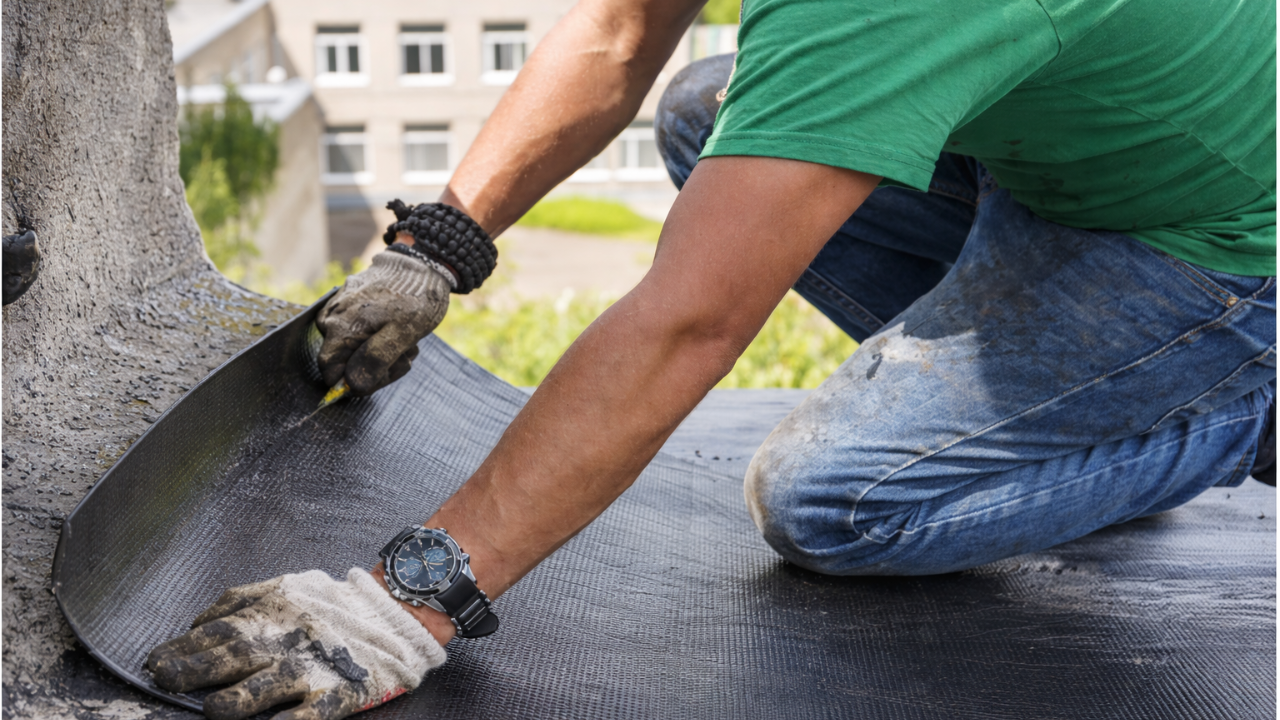
Waterproofing membrane selection is determined by structural zone, water pressure class, movement tolerance, and finish compatibility — not by cost alone. Each of Singapore’s 6 primary waterproofing zones requires a different membrane specification.
Basement Slabs and Below-Grade Walls
Self-adhesive HDPE membrane or torch-on modified bitumen membrane is specified for basement slabs and below-grade walls — both types resist sustained hydrostatic pressure from Singapore’s groundwater table at 1.0m–3.5m depth.
- Positive-side application: membrane applied to the exterior face of the basement wall before backfill; self-adhesive HDPE preferred for vertical wall application as it does not require torch equipment in the confined excavation space
- Blind-side application: self-adhesive HDPE membrane applied to the lagging wall or formwork face before the structural concrete wall is poured against it; the concrete pour bonds the membrane in place; used in Singapore urban construction where no perimeter excavation space exists
- Horizontal slab application: membrane applied to the prepared mud slab or blinding concrete before the structural basement slab is poured; overlap joints are the critical quality control point — all joints taped and inspected before concrete pour
Roof Slabs, Flat Roofs, and Podium Decks
Modified bitumen torch-on (SBS) is the most widely specified system for Singapore flat roof waterproofing. PVC or TPO thermoplastic sheet is specified for large commercial roofs where heat reflection and long service life are design requirements.
- Screed falls: Singapore flat roof design specifies a minimum 1:80 screed fall to all roof drains before membrane application — ponding water above 25mm depth causes accelerated membrane degradation; screed falls are confirmed before membrane installation
- Roof drain details: the membrane must turn up and lap into the roof drain body by minimum 100mm; inadequate drain detailing is the most common source of flat roof leaks in Singapore commercial buildings
- Protection screed: a 40mm–50mm sand-cement protection screed is laid over the waterproofing membrane before any foot traffic, planters, mechanical equipment, or additional build-up — prevents membrane puncture during subsequent construction activities
Wet Area Floors — Bathrooms and Kitchens
Waterproofing membrane (1K or 2K) is the standard specification for wet area floor waterproofing under tile in Singapore residential and commercial bathrooms and kitchens — specified under BCA CP 82:2016 for all wet areas in residential buildings.
- Application zones: full floor area + 300mm up all walls from the finished floor level; 150mm up walls behind wet area fittings; up to the full wall height in shower enclosures with shower heads above 1,500mm floor level
- Tile adhesive compatibility: cementitious membrane cures to a hard surface that accepts tile adhesive directly without additional priming — the same surface chemistry as concrete; no bonding agent required between the cementitious membrane and the tile adhesive layer
- Flood test: Singapore construction practice requires a 24-hour flood test (25mm water depth) on wet area membrane before tiling — a mandatory quality check before the waterproofing layer is concealed under tiles
Balconies, Planter Boxes, and External Terraces
Polyurethane liquid-applied membrane is the most effective specification for Singapore balconies, planter boxes, and external terraces — its seamless coverage, crack-bridging elongation of 300–600%, and UV stability address all the failure modes specific to these exposure zones.
- Planter boxes: planters present 3 simultaneous waterproofing challenges — sustained water exposure from irrigation, root penetration from growing plants, and thermal cycling; PU membrane’s elasticity accommodates root pressure without tearing; root-resistant PU formulations prevent root penetration through the membrane layer
- Balcony drainage: all balcony membranes must be continuous under drainage channels and floor drain outlets; PU liquid-applied membrane conforms to all substrate geometry including drain gullies, step-downs, and wall-to-floor junctions without cutting or folding
Retaining Walls and Underground Car Parks
Self-adhesive HDPE membrane or torch-on modified bitumen is specified for Singapore retaining walls and underground car park slabs — both structures face sustained groundwater pressure and require membranes with 0.3 MPa+ water pressure resistance.
- Car park deck (occupied slab): car park slabs carrying vehicle loads require a membrane that withstands mechanical abrasion from tyres and vehicle loads above the membrane — a heavy protection screed (minimum 60mm) or wearing screed is laid over the membrane before the traffic surface
- Retaining wall drainage: retaining wall waterproofing is combined with a drainage composite layer (geocomposite or gravel drainage blanket) to relieve hydrostatic pressure behind the wall — membrane and drainage system are specified together
How Is a Self-Adhesive Waterproofing Membrane Installed?
Self-adhesive waterproofing membrane installs in 6 steps: substrate preparation, priming, positioning the roll, peeling the release liner, pressing and rolling, and sealing overlaps and terminations — with the entire application completed without open flame or heat equipment.
- Prepare the substrate: the concrete or screed substrate must be clean, dry or damp (not wet with standing water), structurally sound, and free from all dust, oil, loose particles, form release agents, and curing compound residue; repair all surface cracks wider than 0.5mm with non-shrink grout or epoxy mortar before membrane application; fill all honeycombs and blow-holes flush with the surrounding surface; sharp protrusions that could puncture the membrane must be ground flat
- Prime the substrate: apply the manufacturer-specified bituminous primer or solvent-based primer to all concrete surfaces that will receive the membrane; primer improves adhesion between the self-adhesive layer and the porous concrete substrate; allow primer to dry fully (typically 30–60 minutes) until tack-dry but not fully cured; apply primer to all fillets, coves, and upstand corners at the same time
- Form coves and fillets at all internal corners: all internal angle joints (wall-to-floor, wall-to-wall) must be filled with a cement mortar fillet (45° chamfer, minimum 50mm × 50mm) before the membrane is applied; sharp right-angle corners prevent the membrane from lying flat and create stress concentration points where the adhesive bond can fail; the fillet surface must be primed before the membrane overlaps it
- Position and peel the membrane: position the membrane roll at one end of the application area before peeling the release liner; peel 300mm–500mm of release liner at a time as the roll is pressed onto the primed substrate; maintain membrane alignment to the 60mm overlap line marked on the roll; do not peel the full roll length before bonding — partial peel-and-press prevents misalignment and air entrapment under the membrane
- Press and consolidate: press the membrane firmly onto the substrate using a hard rubber roller or wooden board immediately after release liner removal; roll in 2 perpendicular directions across the full applied area to eliminate air pockets and ensure full contact adhesion between the self-adhesive layer and the primed concrete; pay particular attention to membrane edges, corners, and the areas around any penetrations or upstands
- Seal overlaps, edges, and penetrations: all longitudinal overlaps must be minimum 60mm; all transverse (end-lap) overlaps must be minimum 100mm; press overlap seams with a seam roller to ensure full adhesion across the overlap width; apply mastic sealant or self-adhesive flashing strip to all membrane termination edges, pipe penetrations, and upstand corners; inspect all laps for lifting edges before the concrete cover slab or protection layer is placed
The 3 most critical installation details for self-adhesive membrane systems: (1) prime all substrate surfaces including coves and fillets before membrane application — unprimed concrete produces adhesion failure at low peel strength; (2) all overlap joints must be pressed with a seam roller — finger pressure alone is insufficient for full adhesive contact; (3) protect the installed membrane with a screed or concrete pour within 48 hours of installation — prolonged UV exposure degrades the bitumen adhesive layer and reduces bond strength.
How Do You Select the Right Waterproofing Membrane for a Project?
Waterproofing membrane selection is determined by 5 criteria: structural zone and water pressure class, substrate movement tolerance, application method constraints, finish compatibility, and project programme.
- Structural zone and water pressure class: below-grade structures with hydrostatic pressure (basements, lift pits, underground car parks) require membranes rated at 0.3 MPa+ (self-adhesive HDPE, torch-on modified bitumen); wet areas under tiles require cementitious membrane; roofs and exposed terraces require either torch-on or PU liquid-applied membrane; each zone has a different primary stress and the membrane must be specified against that stress
- Substrate movement tolerance: structures with expected movement, thermal cycling, or live loads above the membrane (car parks, roof terraces with foot traffic) require elastic membrane types — PU liquid-applied (elongation 300–600%) or self-adhesive HDPE; static structures without dynamic load (basement slabs, water tanks) are suitable for cementitious or rigid bitumen systems
- Application method constraints: torch-on membrane requires open flame — not permitted in Singapore occupied buildings, near combustible materials, or in confined spaces without ventilation; self-adhesive HDPE or PU liquid-applied membrane is specified when flame restriction applies; PU spray application is faster than roller for large commercial areas but requires spray equipment and protective equipment for the application crew
- Finish compatibility: wet area membranes under ceramic or porcelain tile must be compatible with the tile adhesive system specified — cementitious membrane is directly compatible with cement-based tile adhesives; PU membrane requires a primed surface before tile adhesive application; HDPE sheet membrane requires a screed or concrete cover before tiles can be laid
- Project programme: self-adhesive HDPE membrane is the fastest sheet system — installation rates of 200–400 sqm per crew per day with no drying or curing time before concrete pour; PU liquid-applied requires 24–72 hours cure time before foot traffic or tile adhesive application; torch-on modified bitumen is intermediate — no curing time after bonding but torch skill requirement limits installation rate on detailed areas
For below-grade Singapore construction projects — basement foundations, retaining walls, and underground car park slabs — the Cemimax Asia self-adhesive waterproofing membrane (1.0mm or 1.5mm, 1m × 20m rolls) delivers 0.3 MPa water pressure resistance, 1.5 N/mm peel strength, and wet-bonding capability for application on damp concrete. Contact Cemimax Asia at cemimaxasia.com for technical specifications and project supply.
What Are the Common Waterproofing Membrane Failures in Singapore?
There are 6 common causes of waterproofing membrane failure in Singapore construction — inadequate substrate preparation, joint and termination detail failure, insufficient membrane thickness, incompatible membrane and finish system, application in adverse weather, and absence of a protection layer — all of which are workmanship and specification errors, not material failures.
- Inadequate substrate preparation: the most common cause of membrane failure; a substrate with dust, oil, form release agent, or curing compound residue prevents adhesion; for self-adhesive and liquid-applied membranes, the adhesion failure manifests as membrane delamination — the membrane lifts as a complete sheet leaving the substrate dry; preparation must achieve a CSP 2–3 surface profile confirmed by visual inspection before any primer is applied
- Joint and termination detail failure: sheet membrane systems fail almost exclusively at joints, overlaps, corners, drain outlets, and pipe penetrations — not through the membrane field; inadequate overlap width (below 60mm), unrolled or lifted overlap edges, and unsealed pipe penetrations account for over 70% of all sheet membrane water ingress claims in Singapore construction; all details must be inspected and photographed before concrete pour or protection screed
- Insufficient membrane thickness: liquid-applied membranes (PU and cementitious) applied below the specified dry film thickness — caused by under-application rate per coat or diluting the product — produce a membrane with insufficient crack-bridging capacity and water pressure resistance; wet film thickness must be measured with a wet film comb at each application for quality control; do not thin liquid waterproofing products unless specifically stated in the product datasheet
- Incompatible membrane and finish system: PVC sheet membrane installed in contact with bitumen-based products dissolves — the plasticisers in PVC migrate into bitumen, causing PVC embrittlement and bitumen softening at the contact point; torch-on bitumen installed directly below a PU coating without the specified separation layer causes adhesion failure; specify the full membrane system (primer + membrane + protection) from a single manufacturer and verify compatibility in writing
- Application in rain or standing water: torch-on membrane applied to a wet concrete surface traps steam between the membrane and substrate during torch heating — the steam pressure creates blister formations that delaminate the membrane from the substrate; cementitious coatings applied during rain dilute the mix water ratio and reduce compressive strength; self-adhesive HDPE is the only membrane type rated for application to damp (not wet) substrates
- No protection layer over membrane: an installed waterproofing membrane left unprotected on a Singapore construction site is subject to puncture from construction activity, UV degradation of the bitumen adhesive, and physical damage from foot traffic; install a minimum 40mm–50mm sand-cement protection screed over any membrane that will be subjected to subsequent construction loading; the protection layer is not optional — it is part of the specified waterproofing system
A waterproofing membrane is a continuous impermeable barrier layer applied to concrete and masonry structures to prevent water and moisture penetration — protecting embedded reinforcement from corrosion, maintaining structural integrity, and preventing water ingress into occupied spaces.
There are 5 main waterproofing membrane types — self-adhesive HDPE, modified bitumen torch-on, cementitious, polyurethane liquid-applied, and PVC/TPO thermoplastic — each suited to a specific structural zone, water pressure class, and movement tolerance. In Singapore’s tropical construction environment — 2,340mm annual rainfall, 70–90% ambient humidity, daily thermal cycling, and a groundwater table at 1.0m–3.5m depth — the correct membrane specification for each structural zone is a structural performance decision, not a cost-saving variable.
Waterproofing membrane failure results from workmanship and specification errors — inadequate substrate preparation, inadequate overlap joints, insufficient dry film thickness, system incompatibility, and absent protection layers — not from material quality. Specifying the correct membrane type for the structural zone, applying it to a correctly prepared substrate, verifying all joint and termination details, and installing a protection layer before backfill or construction loading are the 4 non-negotiable requirements for a waterproofing membrane system that performs for its full service life.
For self-adhesive waterproofing membrane supply, technical data sheets, and project consultation for Singapore construction projects, contact Cemimax Asia at cemimaxasia.com.