
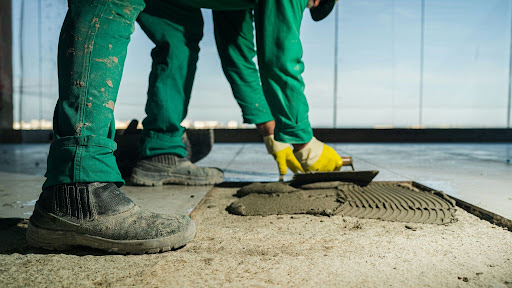
If you’re renovating a home, fitting out a retail unit, or prepping a warehouse floor in Singapore, chances are you’ve searched for “affordable cementitious floor compounds” and found prices ranging wildly from S$15 a bag to S$60 for what looks like the same product. That price gap isn’t random. It comes down to formulation, application area, and what the compound is actually engineered to do.
This guide breaks down what affects pricing, how to spot genuine value versus a false discount, and what to check before you commit so you don’t end up repairing a cracked floor six months after “saving money.”
What Are Cementitious Floor Compounds?
Cementitious floor compounds are cement-based mixes used to level, smooth, patch, or resurface concrete and other subfloors before final flooring (tiles, vinyl, epoxy, carpet) is installed. They fall into a few main categories:
- Self-leveling compounds – flow naturally to create a smooth, level surface
- Patching compounds – fill cracks, holes, and minor surface damage
- Smoothing compounds – correct texture before adhesive or coating application
- Screeds – thicker cementitious layers used for structural leveling
Each type serves a different purpose, which is the first reason prices vary so much comparing a patching compound to a self-leveling compound on price alone is like comparing paint primer to full paint.
Why “Affordable” Doesn’t Have to Mean Low Quality
In Singapore’s competitive construction and renovation market, “affordable” is often mistaken for “cheapest available.” The two aren’t the same. A genuinely affordable compound balances three things: material cost, coverage efficiency, and lifespan. A cheaper bag that needs a thicker application or fails within two years often ends up costing more per square metre over time than a slightly pricier, well-engineered product.
Average Price Ranges in Singapore (2026)
| Compound Type | Typical Price Range (20–25kg bag) | Coverage (approx.) | Best For |
|---|---|---|---|
| Basic patching compound | S$15 – S$25 | 2–3 mm layer, small areas | Minor cracks, spot repairs |
| Standard self-leveling compound | S$25 – S$40 | Up to 10 mm layer | Residential floors before tiles/vinyl |
| High-strength self-leveling compound | S$40 – S$60 | Up to 30–50 mm, heavy traffic | Commercial, healthcare, high-footfall areas |
| Decorative overlay / polished finish | S$50 – S$80+ | Thin decorative layer | Showrooms, offices, feature floors |
Prices are indicative market ranges and can vary by supplier, project volume, and site conditions. Request a formal quotation for accurate project-specific pricing.
What Actually Drives the Price?
| Factor | Why It Matters |
|---|---|
| Compressive strength | Higher-strength compounds cost more but resist cracking under heavy loads |
| Setting/drying time | Fast-setting formulas reduce labour time but often carry a price premium |
| Application thickness | Compounds rated for thicker pours (30–50mm) require more advanced binders |
| Emission rating | Low-emission, eco-friendly formulations (important for healthcare/education projects) cost more to produce |
| Brand and technical support | Suppliers offering technical data sheets, on-site guidance, and warranties typically price slightly higher but reduce project risk |
| Bulk purchase volume | Larger orders usually unlock better per-bag pricing |
How to Choose an Affordable Compound Without Cutting Corners
- Match the product to the job. Don’t buy a heavy-duty commercial-grade compound for a small residential patch you’ll overpay. Equally, don’t use a basic patching compound under a high-traffic commercial floor.
- Check the technical data sheet (TDS). Reputable suppliers publish TDS and safety data sheets (SDS) for every product. If a supplier can’t provide these, treat the “low price” as a red flag.
- Ask about coverage, not just bag price. A S$45 bag that covers 5m² at the required thickness may be cheaper per square metre than a S$30 bag that only covers 3m².
- Factor in labour and rework costs. Compounds that shrink, crack, or set unevenly often require costly rework the “savings” disappear fast.
- Buy from established local suppliers. Suppliers with a Singapore track record understand local humidity, substrate conditions, and building codes, which reduces the risk of compatibility issues.
Common Mistakes Buyers Make on a Budget
- Ignoring substrate preparation – even the best compound fails on a poorly primed or dusty subfloor.
- Underestimating quantity – running short mid-application causes visible seams and inconsistent leveling.
- Skipping the primer step – a cheap compound without proper primer is a common cause of premature failure.
- Choosing based on price per bag alone – without checking coverage area and strength rating, “cheap” can quickly become expensive.
Why Experience Matters When Buying Cementitious Compounds
Cementitious flooring performance depends heavily on formulation consistency and application know-how not just the product itself. Cemimax Asia has supplied adhesives, self-leveling compounds, and related flooring materials to residential, commercial, education, and healthcare projects across Singapore for more than 25 years. Our team provides technical data sheets, safety documentation, and on-ground guidance so you can select a compound that fits your budget without compromising on durability or safety compliance.
Final Thoughts
Affordable cementitious floor compounds in Singapore exist across every budget the key is matching the right product to your project’s traffic, substrate, and finish requirements, rather than choosing purely on sticker price. A well-specified, mid-range compound almost always outperforms an undersized “budget” option in total cost of ownership.
Need help selecting the right compound for your project? Contact Us for technical guidance, product data sheets, and a project-specific quote.