
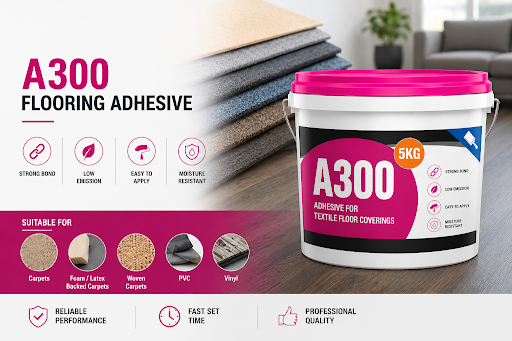
Choosing the right flooring adhesive is an important part of a successful floor installation. Even high-quality carpet, textile flooring or resilient floor coverings can experience lifting, movement or poor bonding when the adhesive is not matched to the flooring material and substrate.
For interior flooring projects, Cemimax A300 Adhesive is designed as a low-emission dispersion adhesive for a wide range of textile coverings. It is intended for residential and commercial interior applications where reliable adhesion, good initial grab and a durable bonding layer are important.
But what makes a textile flooring adhesive suitable for professional installation? And how should an adhesive such as A300 be selected and applied?
Let’s explore the key considerations.
What Is Cemimax A300 Adhesive?
Cemimax A300 is a modified polyacrylate-copolymer dispersion adhesive designed for bonding textile and selected resilient flooring materials in interior applications.
The adhesive forms strong polymer threads that create a resilient bonding layer between the prepared substrate and flooring covering. The manufacturer describes A300 as a universal adhesive for textile coverings, with low emissions and strong bonding performance.
It is particularly relevant for flooring contractors working with different types of carpet and textile floor coverings.
Key characteristics include:
- Low-emission formulation
- High initial grab
- Strong final bonding strength
- Good resistance to interior moisture exposure
- High coverage efficiency
- Suitable for interior flooring applications
- Available in multiple package sizes
What Flooring Materials Can A300 Be Used For?
One of the most important considerations when selecting a flooring adhesive is compatibility with the floor covering.
Cemimax A300 is designed for several types of textile and resilient flooring systems.
According to the product documentation, suitable applications include:
Textile Coverings with Synthetic Backing
A300 can be used with textile coverings featuring synthetic secondary backings, making it suitable for many commercial and residential carpet installations.
Foam-, Latex- or Fleece-Backed Carpets
Different carpet constructions require appropriate adhesive compatibility. A300 is specified for coverings with foam, latex or fleece backings.
Woven and Needlepunch Carpets
The adhesive is also specified for woven goods, needlepunch carpets and natural fibre carpets.
Felt-Backed PVC
A300 can be used with felt-backed PVC flooring.
Cushioned Vinyl
The technical documentation specifies cushioned vinyl coverings with a thickness below 2 mm as another suitable application.
Always confirm compatibility between the specific floor covering, adhesive and substrate before installation.
Why Is the Adhesive Important in Carpet Installation?
When people think about flooring installation, they often focus on the carpet or floor covering itself.
However, the adhesive plays an equally important role.
A flooring adhesive needs to create sufficient contact between the substrate and covering while accommodating the requirements of the flooring system.
Poor adhesive selection or application can contribute to problems such as:
- Lifting edges
- Movement
- Poor bonding
- Uneven adhesion
- Air pockets
- Premature flooring failure
A professional flooring system therefore involves more than simply spreading adhesive onto the floor.
Substrate preparation, adhesive selection, application technique and curing conditions all matter.
What Makes A300 Suitable for Professional Flooring Applications?
Cemimax A300 combines several characteristics that are relevant to professional flooring installation.
High Initial Grab
Initial grab refers to the adhesive’s ability to hold the flooring material in position during installation.
This can be particularly useful when installing textile coverings because maintaining proper positioning during installation is important for achieving clean seams and consistent results.
Strong Final Bond
Initial grab is only one part of adhesive performance.
Once the adhesive cures, it needs to develop a durable bond. A300 is designed to develop strong final bonding strength as the polymer cures.
Low-Emission Formulation
Indoor air quality is increasingly important in residential, commercial and institutional environments.
Cemimax describes A300 as a low-emission dispersion adhesive designed for interior applications.
This characteristic can be particularly relevant for projects where flooring is installed inside occupied buildings.
Understanding A300 Adhesive Coverage
According to the current product documentation, Cemimax A300 has a consumption rate of approximately 160–200 g/m².
Actual consumption can vary depending on factors such as:
- Substrate condition
- Surface texture
- Trowel selection
- Flooring backing
- Installer technique
- Adhesive transfer requirements
For this reason, coverage figures should be treated as a guide rather than a guarantee for every installation.
A smooth, properly prepared substrate may require a different amount of adhesive than a rough or highly absorbent surface.
How Is Cemimax A300 Applied?
Proper application is essential to achieving reliable flooring performance.
The product documentation recommends thoroughly stirring A300 before application and spreading it evenly using an A2 or A3 toothed trowel.
A typical installation process involves several stages.
Step 1: Prepare the Substrate
The substrate should be suitable, stable and properly prepared.
Any required primer or smoothing compound should be fully dry before adhesive application.
This is an important part of the flooring installation system because the adhesive cannot compensate for an unsuitable or poorly prepared substrate.
Step 2: Stir the Adhesive
Thoroughly stir the product before use to ensure consistent application.
Step 3: Apply the Adhesive
Apply the adhesive evenly using the appropriate toothed trowel.
The selected trowel should be suitable for the flooring material and installation conditions.
Step 4: Observe the Open Time
A300 has a specified open time of approximately 5–30 minutes under normal conditions, according to the current product data.
Open time can be affected by temperature, humidity, substrate absorption and other site conditions.
Step 5: Install the Flooring
Place the flooring material onto the adhesive according to the manufacturer’s installation requirements.
Step 6: Roll or Press the Flooring
After placing the flooring, the surface should be pressed or rolled to help remove trapped air and ensure proper adhesive transfer.
Cemimax specifically recommends using a roller or suitable pressure method to ensure the adhesive transfers adequately to the back of the flooring material.
How Long Does Cemimax A300 Take to Cure?
Understanding drying and curing times is essential when planning a flooring installation project.
The current technical information indicates:
| Property | Cemimax A300 |
| Binder | Modified polyacrylate-copolymer |
| Colour | Cream-white |
| Consumption | 160–200 g/m² |
| Open time | 5–30 minutes |
| Working time | 1–2 hours |
| Set to traffic | 24–48 hours |
| Final strength | 5–7 days |
| Minimum working temperature | 15°C at floor level |
| Packaging | 5kg, 10kg, 20kg |
| Shelf life | Minimum 12 months |
These figures are provided under specified conditions and can vary depending on the actual installation environment.
Flooring contractors should always refer to the current technical data sheet and project requirements before determining when newly installed flooring can receive traffic.
Why Substrate Preparation Matters
Even the best carpet adhesive cannot overcome a fundamentally unsuitable substrate.
Before applying A300, the floor should be properly prepared according to the requirements of the flooring system.
Depending on the project, preparation may involve:
- Cleaning
- Removing contaminants
- Repairing damaged areas
- Priming
- Smoothing uneven surfaces
- Allowing primers or levelling compounds to dry
- Checking the substrate condition
Cemimax’s product range includes primers, moisture-related products, patching compounds and self-leveling compounds that form part of a broader flooring preparation system.
This highlights an important principle:
A successful flooring installation is a system, not just an adhesive.
A300 Adhesive for Residential Flooring
Residential projects can involve carpets, textile coverings and other flooring materials where appearance, comfort and indoor environmental considerations are important.
A low-emission adhesive can be relevant for interior spaces such as:
- Bedrooms
- Living rooms
- Home offices
- Apartments
- Residential developments
A300’s suitability for textile coverings makes it an option for residential flooring systems where the specific covering and substrate are compatible.
A300 Adhesive for Commercial Flooring
Commercial environments often demand reliable flooring installation because the finished floor may experience regular foot traffic.
Potential applications include:
- Offices
- Retail environments
- Hospitality interiors
- Commercial buildings
- Residential developments
- Other interior spaces
The specified 24–48 hour traffic-setting period can also be useful when planning installation schedules, although actual site conditions should always be considered.
A300 vs Choosing an Adhesive for Resilient Flooring
Not every flooring adhesive is designed for every flooring material.
This is why selecting an adhesive based only on the words “flooring adhesive” can be problematic.
For example, Cemimax also offers A390, which is positioned for resilient synthetic floor and wall coverings.
A300, by contrast, is particularly focused on textile coverings and selected materials such as felt-backed PVC and thin cushioned vinyl.
Therefore, contractors should always match:
Flooring material → Backing → Substrate → Adhesive → Installation method
rather than selecting an adhesive solely by brand or general category.
How to Choose the Right Flooring Adhesive
Before purchasing a floor adhesive for carpet or textile flooring, consider the following.
1. Identify the Floor Covering
Determine whether you’re installing:
- Carpet
- Textile flooring
- Natural fibre flooring
- PVC
- Vinyl
- Resilient flooring
- Another covering
2. Check the Backing
The backing material can influence adhesive compatibility.
3. Assess the Substrate
Concrete, screed and existing flooring systems can have different preparation requirements.
4. Consider Indoor Conditions
Temperature and humidity can influence adhesive working and curing behaviour.
5. Check Application Requirements
Look at:
- Trowel type
- Coverage
- Open time
- Working time
- Traffic time
- Final curing
6. Follow the Technical Data Sheet
Always use the manufacturer’s current technical documentation for the specific product and application.
Common Flooring Adhesive Installation Mistakes
Even a suitable adhesive can perform poorly when installation conditions are incorrect.
Some common mistakes include:
Applying Adhesive to an Unprepared Substrate
Dust, contaminants or unstable surfaces can interfere with adhesion.
Using the Wrong Trowel
Incorrect adhesive application can affect coverage and transfer.
Ignoring Open Time
Installing flooring too early or too late can affect adhesive performance.
Failing to Roll the Flooring
Insufficient pressure can leave trapped air or reduce adhesive transfer.
Allowing Premature Traffic
Walking on a newly installed floor before the adhesive has adequately set can affect the installation.
Ignoring Temperature Requirements
The technical data for A300 specifies a minimum working temperature of 15°C at floor level. Storage and handling instructions also require protection from frost and direct sunlight.
Storage and Handling of A300
Correct storage is important for maintaining adhesive performance.
Cemimax recommends storing A300 in sealed containers and protecting it from frost and direct sunlight. The current product information specifies a minimum shelf life of 12 months under appropriate storage conditions.
The product documentation also specifies that application temperatures should meet the manufacturer’s requirements.
Always consult the current technical and safety data sheets before handling or installing the product.
Why Choose a Low-Emission Flooring Adhesive?
Low-emission products can be particularly relevant in interior construction because flooring materials and installation products contribute to the overall indoor environment.
Cemimax describes A300 as a low-emission dispersion adhesive for interior applications.
For projects such as offices, homes and other occupied buildings, product selection can therefore consider not only bonding performance but also indoor environmental requirements.
Final Thoughts
Choosing the right textile flooring adhesive requires more than looking at bonding strength.
The flooring material, backing, substrate, application technique, working conditions and curing schedule all influence the final installation.
Cemimax A300 Adhesive is designed as a low-emission dispersion adhesive for textile coverings and selected resilient flooring applications. It offers high initial grab, strong final bonding, good interior moisture resistance and a stated consumption rate of 160–200 g/m².
Its specified applications include synthetic-backed textile coverings, foam-, latex- and fleece-backed carpets, woven and needlepunch carpets, natural fibre flooring, felt-backed PVC and cushioned vinyl below 2mm thickness.
For professional flooring contractors, the key is to treat A300 as part of a complete installation system: prepare the substrate correctly, select the appropriate adhesive, follow the recommended application method and allow sufficient time for setting and final strength development.
For the most accurate installation requirements, always refer to the latest Cemimax A300 Technical Data Sheet and Safety Data Sheet before use.
Frequently Asked Questions
What is Cemimax A300 Adhesive used for?
Cemimax A300 is a low-emission dispersion adhesive primarily designed for textile floor coverings and selected resilient flooring applications in interior environments.
Can Cemimax A300 be used for carpet?
Yes. It is specified for several carpet types, including synthetic-backed, foam-backed, latex-backed, fleece-backed, woven, needlepunch and natural fibre carpets.
Can A300 be used for PVC flooring?
It can be used for felt-backed PVC flooring and cushioned vinyl coverings below 2mm thickness, subject to compatibility with the specific flooring system.
How much Cemimax A300 is required per square metre?
The specified consumption is approximately 160–200 g/m², although actual consumption can vary depending on the substrate, flooring backing and application method.
How long does Cemimax A300 take to dry?
The current product data specifies approximately 24–48 hours to set to traffic, while final strength development is listed at approximately 5–7 days under normal conditions.
Which trowel should be used for A300?
Cemimax specifies an A2 or A3 toothed trowel for application, with the appropriate choice depending on the flooring system and installation requirements.
Is Cemimax A300 suitable for commercial flooring?
Yes. Cemimax positions A300 for interior residential and commercial applications, particularly textile flooring installations.
Does the floor need to be prepared before applying A300?
Yes. Primers and smoothing compounds, where required, should be fully dry before A300 is applied. Proper substrate preparation is essential for reliable flooring adhesion.
What is the difference between A300 and A390?
A300 is primarily positioned for textile coverings and selected resilient materials, while Cemimax A390 is designed for resilient synthetic floor and wall coverings. The correct choice depends on the flooring material, backing and installation system.