
A smooth and level subfloor is one of the most important foundations for a successful flooring installation. Whether the final floor is vinyl, tile, wood, carpet or another resilient covering, unevenness in the substrate can affect appearance, adhesive performance and long-term durability.
This is where a self-leveling compound can play an important role.
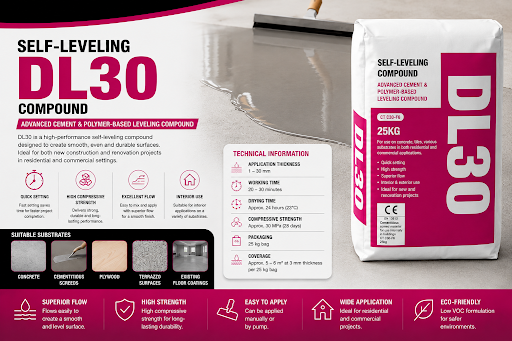
Cemimax DL30 Self-Leveling Compound is an advanced cement and polymer-based levelling and smoothing compound designed for interior flooring preparation. It can be used on new or existing substrates and is formulated to provide good flow, high coverage and a smooth, strong underlayment for subsequent flooring systems.
What Is Cemimax DL30 Self-Leveling Compound?
Cemimax DL30 is a cement-based self-leveling and smoothing compound containing special cements, mineral fillers, polyvinyl-acetate copolymers, flow agents and additives.
When mixed with clean water, it produces a hydraulic-setting compound that can be spread across a prepared subfloor to correct unevenness and create a more consistent surface.
The product is intended for interior use on new and existing substrates, including trafficable areas where a suitable underlayment is required.
Key benefits include:
- Quick-setting formulation
- Superior flow properties
- High coverage
- High compressive strength
- Flexible hand-mix or pump application
- Suitable for interior applications
- Designed for 1–30 mm levelling requirements
- Suitable for residential and commercial flooring preparation
Why Is a Self-Leveling Compound Important?
Even a professionally constructed subfloor may contain:
- Depressions
- Minor height variations
- Surface irregularities
- Uneven transitions
- Small imperfections
- Areas requiring additional levelling before flooring installation
Installing a finished floor directly over an uneven substrate can make imperfections visible through the flooring or interfere with the installation system.
A floor levelling compound provides a way to create a more consistent surface before the final flooring material is installed.
Cemimax’s self-leveling range is designed to provide smooth and stable substrates for flooring systems including vinyl, tile, wood and carpet.
What Makes Cemimax DL30 Different?
DL30 combines cement-based strength with polymer modification and flow-enhancing additives.
The result is a material that can be mixed into a fluid consistency, poured onto the prepared floor and distributed to the required thickness.
Its technical data identifies several properties that make it suitable for professional flooring preparation:
Superior Flow
Good flow allows the compound to spread efficiently across the prepared surface, helping create a consistent levelling layer.
High Compressive Strength
DL30 reaches approximately 30 MPa compressive strength after 28 days, according to the current technical data sheet.
Quick Setting
The specified working time is approximately 20–30 minutes, allowing flooring contractors to progress efficiently when site conditions are suitable.
Flexible Application
DL30 can be applied manually or using pump application, making it suitable for different project sizes and installation workflows.
Where Can Cemimax DL30 Be Used?
DL30 is designed for interior flooring applications.
The product information identifies applications including:
- Concrete substrates
- Cementitious screeds
- Uneven subfloors
- Renovation substrates
- New construction substrates
- Trafficable interior areas
- Subfloors requiring 1–30 mm levelling
- Preparation for resilient flooring
- Preparation for wood flooring
- Preparation for tile flooring
The exact application should always be checked against the flooring manufacturer’s requirements and the current DL30 technical documentation.
Can DL30 Be Used on Concrete?
Yes.
Concrete and cementitious screeds are among the principal substrate types for DL30.
However, the concrete surface must be properly prepared before the compound is applied.
The substrate should be:
- Structurally sound
- Dry
- Clean
- Free from dust
- Free from grease
- Free from loose materials
- Free from substances that could interfere with adhesion
Weak areas should be mechanically removed or treated appropriately before applying the recommended primer.
Can DL30 Be Used on Plywood?
The Cemimax product page identifies plywood among the suitable interior subfloors for DL30.
However, wood-based substrates require careful preparation.
Before applying a self-leveling compound over plywood, contractors should verify:
- Subfloor stability
- Structural movement
- Moisture conditions
- Surface cleanliness
- Primer compatibility
- Flooring manufacturer’s requirements
A self-leveling compound should not be expected to correct movement in an unstable subfloor.
How Thick Can Cemimax DL30 Be Applied?
DL30 is designed for levelling applications from approximately 1 mm to 30 mm, depending on the installation configuration.
The technical data sheet specifies that DL30 can be applied from 1–10 mm in one application, while the recommended installation thickness can range from 1–30 mm.
This makes it useful for both relatively minor surface correction and thicker levelling requirements.
For thicker applications, contractors should follow the current manufacturer’s instructions regarding application method, layer thickness and drying.
How to Apply Cemimax DL30
Correct substrate preparation and mixing are essential for achieving the intended performance.
Step 1: Prepare the Subfloor
Remove dust, dirt, grease and loose material.
Weak areas should be mechanically prepared using suitable methods such as brushing, abrading, grinding or shot blasting where required.
The substrate should be sound, dry and suitable for the complete flooring system.
Step 2: Apply the Recommended Primer
The appropriate Cemimax primer should be selected based on the substrate.
The primer should be allowed to dry thoroughly before DL30 is installed.
This is an important part of the flooring system because the primer helps establish the appropriate bonding interface.
Step 3: Measure Clean Water
For a 25 kg bag of DL30, the technical data sheet specifies approximately 5.25–6 litres of cold, clean water.
The exact mixing requirement should always be confirmed against the current product documentation.
Step 4: Add the Powder
Add the 25 kg contents gradually while stirring briskly.
A suitable drill or mixer fitted with a mixing paddle should be used.
Step 5: Mix Thoroughly
Mix for approximately 3 minutes to achieve a homogeneous, lump-free consistency.
The technical documentation specifically cautions against mixing the material too thinly.
Step 6: Pour and Spread
Pour the mixture onto the prepared floor.
Spread it uniformly to the required thickness using an appropriate toothed rake.
Step 7: Remove Entrapped Air
A suitable spike roller can be used to help release entrapped air and improve the surface finish.
Step 8: Allow the Compound to Dry
Under the manufacturer’s stated conditions, DL30 has a drying time of approximately 24 hours.
Low temperatures and poor airflow can significantly increase drying time.
Cemimax DL30 Working Time
Working time is an important consideration when planning a self-leveling application.
DL30 has a specified working time of approximately 20–30 minutes under normal conditions.
This means contractors should prepare their materials, equipment and working area before mixing.
Temperature also matters.
The manufacturer recommends application conditions around 18–25°C, with floor temperature above 15°C and relative humidity below 75%.
Higher temperatures can shorten working time, while lower temperatures and high humidity can delay setting and drying.
How Strong Is Cemimax DL30?
Compressive strength is one of the key performance characteristics of a levelling compound.
According to the current DL30 technical data:
| Age | Compressive Strength |
| 1 day | Approx. 15 MPa |
| 7 days | Approx. 25 MPa |
| 28 days | Approx. 30 MPa |
The product also reaches approximately 6 MPa tensile bending strength after 28 days.
This strength development makes DL30 suitable as a high-performance interior underlayment when installed according to the manufacturer’s requirements.
DL30 Coverage
Cemimax lists coverage at approximately 5–6 m² at 3 mm thickness per 25 kg bag.
Actual consumption can vary depending on:
- Subfloor flatness
- Application thickness
- Surface texture
- Material waste
- Installation technique
For accurate project planning, calculate the required quantity based on the actual floor area and specified thickness rather than relying only on a general coverage estimate.
DL30 for New and Existing Subfloors
One advantage of DL30 is its application across both new and existing interior substrates.
New Construction
On new projects, DL30 can help create a consistent surface before the final flooring is installed.
Renovation
During renovation, existing floors may contain irregularities that need to be corrected before installing a new flooring material.
DL30 can therefore be part of a refurbishment system where the existing substrate is suitable and properly prepared.
However, existing weak or unstable layers should be addressed before levelling.
DL30 for Commercial Flooring
Commercial flooring projects often require a smooth and reliable substrate because the finished floor needs to maintain consistent appearance and performance.
DL30 can be used as an underlayment in suitable interior trafficable areas.
Potential applications include:
- Offices
- Retail spaces
- Commercial buildings
- Healthcare environments
- Educational facilities
- Residential developments
- Interior renovation projects
Cemimax Asia positions its flooring products for residential, commercial and healthcare projects in Singapore and across the Asia-Pacific region.
DL30 vs DL59: Which Self-Leveling Compound Should You Choose?
Cemimax offers several self-leveling compounds, so choosing between products should be based on the specific project requirements.
DL30 is positioned as a general high-performance cement and polymer-based levelling and smoothing compound for standard interior applications.
DL59, by comparison, is designed for high-traffic and heavy-wear areas, with Cemimax listing compressive strength up to approximately 40 MPa and rapid hardening.
In simple terms:
DL30 → General interior levelling and smoothing
DL59 → Higher-demand, high-traffic applications
The appropriate product should be selected according to the floor covering, traffic level, substrate and project specifications.
DL30 as Part of a Complete Flooring System
A self-leveling compound should not be viewed as an isolated product.
A professional flooring installation can involve several stages:
Subfloor → Primer → Self-Leveling Compound → Adhesive → Floor Covering
Each component performs a different function.
For example:
- Primer: prepares and promotes adhesion
- DL30: corrects unevenness and creates a smooth underlayment
- Flooring adhesive: bonds the finished floor covering
- Floor covering: provides the final functional and aesthetic surface
Cemimax’s product range includes primers, self-leveling compounds, adhesives, patching compounds and moisture-management products intended to work within complete flooring preparation systems.
Common Mistakes When Using Self-Leveling Compound
Applying Over a Weak Subfloor
A self-leveling compound cannot compensate for a structurally unstable substrate.
Skipping Primer
The correct primer can be essential for adhesion depending on the substrate.
Adding Too Much Water
Over-watering can change the material’s intended performance and should be avoided.
Mixing Incorrectly
Insufficient mixing can result in lumps and inconsistent flow.
Working Outside Recommended Conditions
Temperature and humidity affect working time and drying.
Applying Over Dust or Contamination
Dust, grease and loose materials can compromise adhesion.
Installing Flooring Too Soon
The levelling compound needs adequate drying before the next stage of the flooring system.
Why Choose Cemimax DL30 for Floor Preparation?
Cemimax DL30 combines several characteristics that are valuable for professional floor preparation:
Good flow helps with efficient spreading.
Quick setting can help keep projects moving.
High compressive strength provides a durable underlayment.
1–30 mm levelling capability provides flexibility for different substrate conditions.
Manual or pump application allows contractors to adapt the installation method to the project.
Interior compatibility makes DL30 suitable for residential and commercial flooring preparation.
Final Thoughts
A high-quality floor starts with a properly prepared substrate.
Cemimax DL30 Self-Leveling Compound is designed to create a smoother, more even and stronger foundation for interior flooring installations. Its cement-and-polymer formulation provides good flow, quick setting, high coverage and progressive compressive strength.
With a recommended installation range of approximately 1–30 mm, DL30 can be used for a variety of levelling requirements, from correcting surface irregularities to preparing thicker areas before the final flooring is installed.
For the best results, the installation should follow a complete system:
Assess the substrate → prepare the surface → apply the appropriate primer → mix DL30 correctly → spread to the required thickness → remove entrapped air → allow sufficient drying → install the final flooring.
When these steps are followed according to the manufacturer’s current technical documentation, DL30 can provide a reliable and durable underlayment for residential and commercial interior flooring projects.
Frequently Asked Questions
What is Cemimax DL30 Self-Leveling Compound?
Cemimax DL30 is a cement and polymer-based levelling and smoothing compound designed to create a smooth, even underlayment for interior flooring applications.
What can DL30 be used for?
DL30 can be used for levelling new or existing interior substrates, including concrete and cementitious screeds, and for preparing surfaces for suitable resilient, wood and tile flooring systems.
How thick can Cemimax DL30 be applied?
The product is intended for approximately 1–30 mm levelling requirements, with the technical sheet specifying 1–10 mm in one application.
How much water is needed for DL30?
For a 25 kg bag, the current technical data sheet specifies approximately 5.25–6 litres of cold, clean water.
How long does DL30 take to dry?
Cemimax lists approximately 24 hours drying time at 20°C, although temperature, humidity and airflow can significantly affect actual drying.
How long is the working time?
The specified working time is approximately 20–30 minutes under normal conditions.
How strong is Cemimax DL30?
DL30 reaches approximately 30 MPa compressive strength after 28 days and approximately 6 MPa tensile bending strength after 28 days according to the current technical data sheet.
Can DL30 be used on plywood?
The product page identifies plywood among suitable interior subfloors. However, plywood must be structurally sound, properly prepared and compatible with the complete flooring system.
Can DL30 be pumped?
Yes. Cemimax specifies that DL30 is suitable for both hand-mixing and pump application.
Is DL30 suitable for commercial flooring?
Yes. DL30 is designed for interior trafficable areas and can be used in suitable commercial flooring preparation applications. For particularly heavy-wear environments, Cemimax also offers DL59, which is specifically positioned for high-traffic areas.