
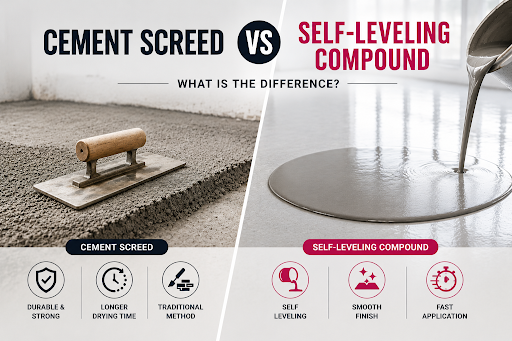
Choosing the right floor preparation material is an important step in any flooring project. Two products commonly considered for preparing and levelling floors are cement screed and self-leveling compound. Although both are used to create a suitable surface for floor finishes, they are designed for different purposes and perform differently during installation.
So, what is the difference between cement screed and self-leveling compound?
Cement screed is generally used to create a strong, durable base and can be installed at greater thicknesses, while a self-leveling compound is designed to correct surface irregularities and produce a smooth, level substrate, often at relatively thin application depths.
For projects in Singapore, understanding the difference can help you choose the appropriate floor levelling solution based on the existing substrate, required thickness, floor finish, project schedule and site conditions.
What Is Cement Screed?
Cement screed is a cement-based mixture typically made from cement and graded aggregate, combined with water and sometimes additional additives depending on the product and application.
It is commonly installed over concrete substrates to create a suitable base for flooring systems such as:
- Porcelain and ceramic tiles
- Natural stone
- Vinyl flooring
- Engineered wood
- Carpet
- Other floor finishes
Cement screed can be used to create falls, build up floor levels and provide a durable substrate for subsequent flooring installation.
Depending on the project, screed may be bonded directly to the substrate or installed as an unbonded or floating screed system where the construction specification requires it.
Main Characteristics of Cement Screed
Cement screed is generally associated with:
- Greater application thickness
- Durable cement-based construction
- Floor level adjustment
- Slope and fall formation
- Traditional screeding techniques
- Suitable preparation for many flooring systems
However, traditional cement screed can require more time for installation, curing and drying before the next flooring stage can begin.
What Is Self-Leveling Compound?
A self-leveling compound, also called a self-leveling underlayment or self-leveling floor compound, is a specially formulated material designed to create a smooth and level surface over an existing substrate.
Unlike conventional screed, self-leveling material is formulated to flow across the floor and reduce minor variations, depressions and surface irregularities.
Once mixed correctly and applied to a suitable prepared substrate, the compound spreads across the floor and can be assisted with tools such as a gauge rake, smoothing tool or spiked roller, depending on the product and application method.
Self-leveling compounds are commonly used before installing floor finishes where a smooth and relatively flat substrate is important.
They can be suitable for applications involving:
- Vinyl flooring
- LVT and resilient flooring
- Carpet
- Engineered flooring
- Tiles, where compatible with the selected system
- Renovation and refurbishment projects
The exact application thickness, drying time and compatible floor finishes depend on the manufacturer’s technical specifications.
Cement Screed vs Self-Leveling Compound: Key Differences
Although both products are used in floor preparation, their functions are not identical.
| Feature | Cement Screed | Self-Leveling Compound |
| Primary Purpose | Build up, level or form a durable floor base | Smooth and level an existing substrate |
| Typical Application | Medium to greater thicknesses depending on system | Generally thinner applications, product dependent |
| Consistency | Mortar-like mixture | Flowable cementitious or polymer-modified compound |
| Application | Manually spread, compacted and finished | Poured, spread and smoothed |
| Surface Finish | Can be finished manually | Produces a smooth, level surface |
| Slope Formation | Suitable for creating falls when properly specified | Generally intended for level surfaces |
| Drying/Curing | Can require longer drying or curing periods | Often faster, but product dependent |
| Typical Use | Floor build-up and substrate formation | Surface correction and floor preparation |
The correct product should always be selected according to the manufacturer’s technical data and the requirements of the flooring system.
Cement Screed vs Self-Leveling Compound: Which Is Stronger?
Strength depends on the specific product formulation, thickness, substrate, preparation, curing conditions and installation quality.
It would therefore be inaccurate to say that one material is always stronger than the other.
Cement screed is commonly selected where a durable cement-based floor base or significant floor build-up is required.
Self-leveling compounds are generally designed for surface levelling and preparation rather than replacing a structural floor system.
For demanding applications, factors such as compressive strength, flexural strength, bond strength and compatibility with the final floor covering should be considered.
Always check the manufacturer’s technical data sheet rather than comparing products based solely on the material name.
When Should You Use Cement Screed?
Cement screed may be appropriate when you need to:
Build Up Floor Levels
If the existing floor is significantly lower than the required finished floor level, a suitable screed system can provide the necessary build-up.
Create Falls or Slopes
Areas such as wet rooms, balconies and other locations may require controlled falls for drainage. A properly specified screed can be used to form these gradients.
Create a Durable Floor Base
Cement screed can provide a robust substrate for a wide range of floor finishes when correctly designed and installed.
Prepare New Construction Floors
Screeding is commonly incorporated into new-build and renovation flooring systems where a suitable base is required before the final floor covering.
When Should You Use Self-Leveling Compound?
Self-leveling compound can be particularly useful when the existing substrate is generally sound but contains minor unevenness, surface imperfections or variations in level.
It can be considered for:
Renovation Projects
Self-leveling products can help prepare existing concrete or cement-based floors before installing a new floor covering.
Smooth Floor Preparation
Floor finishes such as vinyl and LVT can be sensitive to substrate imperfections. A properly prepared smooth substrate can help reduce the risk of imperfections becoming visible through the finished flooring.
Thin Surface Levelling
Where only a relatively thin layer of material is required, a suitable self-leveling compound may be more appropriate than installing a conventional screed.
Faster Floor Preparation
Some self-leveling products are formulated for rapid setting or early floor-covering installation. However, drying and covering times vary significantly between products and environmental conditions.
Can Self-Leveling Compound Be Used Over Cement Screed?
Yes, a compatible self-leveling compound can be installed over a cement-based screed, provided the existing screed is suitable and the manufacturer’s installation requirements are followed.
The substrate normally needs to be:
- Structurally sound
- Clean
- Free from dust and contaminants
- Properly cured or sufficiently dry
- Free from loose material
- Appropriately primed where required
Primers are often important because they can improve adhesion and help control substrate absorption.
The exact preparation procedure depends on the self-leveling product and substrate.
Can You Use Self-Leveling Compound Instead of Screed?
Not always.
A self-leveling compound is not simply a thinner version of conventional cement screed.
If a project requires substantial floor build-up, falls, significant correction or a particular screed construction, a conventional screed system may be more appropriate.
Self-leveling compound is generally better suited to correcting and smoothing an existing substrate within the thickness range specified by the manufacturer.
Choosing the wrong material for the required thickness or application can result in cracking, debonding, shrinkage or other flooring problems.
Which Is Faster: Cement Screed or Self-Leveling Compound?
The answer depends on the specific products and project conditions.
Traditional cement screed can require significant time for installation, curing and drying before a floor finish can be installed.
Some modern self-leveling compounds are formulated for rapid setting and fast return to service, making them useful for renovation and time-sensitive projects.
However, “self-leveling” does not automatically mean “ready for flooring immediately.”
The manufacturer’s technical data should always be checked for:
- Working time
- Setting time
- Walk-on time
- Drying time
- Minimum and maximum thickness
- Moisture requirements
- Floor-covering installation time
What Should You Consider Before Choosing?
The best flooring preparation system depends on the project rather than simply choosing the product with the fastest application time.
Consider these factors:
1. Existing Floor Condition
Is the substrate structurally sound, cracked, contaminated or significantly uneven?
2. Required Thickness
Determine how much material is actually required to achieve the finished floor level.
3. Final Floor Finish
Different floor coverings have different substrate requirements.
4. Moisture Conditions
Substrate moisture and ambient humidity can affect drying and floor-covering installation.
5. Project Schedule
If rapid installation is important, a suitable fast-setting or rapid-drying product may be worth considering.
6. Surface Flatness Requirements
Some floor coverings require a particularly smooth and flat substrate.
7. Compatibility
Primer, screed, self-leveling compound and final floor covering should be compatible as part of the complete flooring system.
Cement Screed or Self-Leveling Compound: Which Is Better?
There is no universal winner because the two materials serve different purposes.
Choose cement screed when you need:
- Floor build-up
- Greater thickness
- A durable cement-based base
- Falls or gradients
- A conventional screed system
Choose self-leveling compound when you need:
- Surface smoothing
- Minor level correction
- A smooth substrate
- Thin-layer levelling
- Efficient preparation before certain floor finishes
In many flooring projects, the two products can actually work together rather than against each other.
A cement screed may establish the required floor level, while a compatible self-leveling compound can subsequently correct surface irregularities and create a smoother substrate for the final flooring.
Why Professional Floor Preparation Matters in Singapore
Singapore’s humid climate makes correct substrate preparation particularly important for flooring projects.
Moisture management, substrate condition, ventilation, product selection and drying conditions can all influence the performance of a flooring system.
Before applying cement screed or self-leveling compound, the floor should be assessed carefully.
A professional flooring contractor or manufacturer can help determine:
- Existing substrate condition
- Required application thickness
- Suitable primer
- Moisture requirements
- Product compatibility
- Drying requirements
- Suitable final floor finish
Correct preparation at this stage can help reduce the risk of flooring failures later.
Cemimax Flooring Solutions
At Cemimax, flooring professionals can explore cementitious flooring solutions designed for different substrate preparation and floor levelling requirements.
Whether your project involves cement screeding, self-leveling, substrate preparation or surface correction, selecting the right product for the specific application is essential.
Rather than choosing solely based on price or application speed, consider the complete flooring system, including the substrate, required thickness, environmental conditions and final floor covering.
The right preparation system can provide a more suitable foundation for a durable and attractive finished floor.
Frequently Asked Questions
What is the main difference between cement screed and self-leveling compound?
Cement screed is generally used to create or build up a durable floor base, while self-leveling compound is primarily used to smooth and level an existing substrate.
Can self-leveling compound replace cement screed?
Not in every application. Self-leveling compound is generally designed for specific levelling thicknesses and surface correction. Where significant floor build-up or falls are required, a suitable screed system may be more appropriate.
Can self-leveling compound be applied over cement screed?
Yes, a compatible self-leveling compound can often be applied over cement screed when the substrate has been properly prepared and meets the manufacturer’s requirements.
Which dries faster, screed or self-leveling compound?
Some self-leveling compounds can offer faster setting and floor-covering times than conventional screed, but drying time depends on the specific product, thickness, temperature, humidity and substrate conditions.
Is self-leveling compound stronger than cement screed?
Neither is universally stronger. Performance depends on the specific formulation and installation conditions. The appropriate technical properties should be assessed according to the intended application.
Is self-leveling compound suitable for uneven concrete floors?
It can be suitable for correcting certain levels of unevenness and surface irregularities, provided the substrate and degree of unevenness are within the product’s specified application range.
Does cement screed need to be completely level?
Not necessarily. Screed can be designed to create falls or gradients where required. The required surface profile depends on the application and final flooring system.
Why is primer used before self-leveling compound?
Primer can improve adhesion and help regulate the absorbency of the substrate. The correct primer and preparation method should be selected according to the manufacturer’s system requirements.
How do I choose between cement screed and self-leveling compound?
Start by assessing the existing substrate, required thickness, floor level, final floor covering, moisture conditions and project schedule. For complex projects, consult a flooring professional or product manufacturer.
Final Takeaway
Cement screed and self-leveling compound are not competing products with exactly the same purpose.
Cement screed is generally suited to floor build-up, durable base construction and forming required levels or falls, while self-leveling compound is designed primarily for surface levelling, smoothing and preparing substrates for subsequent floor finishes.
For the best result, select the material based on the actual substrate and flooring requirements rather than choosing simply based on drying speed or price.
For professional flooring and substrate preparation solutions, explore Cemimax products and choose a system that matches your project’s technical requirements.