
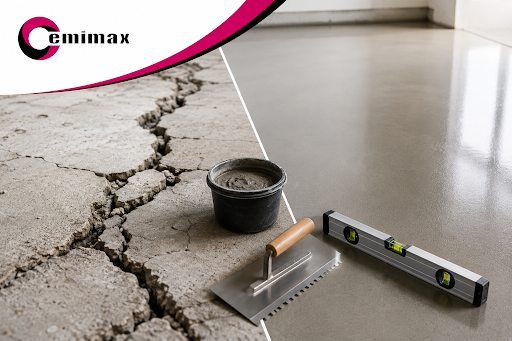
A cracked, pitted, or uneven concrete subfloor is one of the most common reasons flooring installations fail early. Tiles crack along hidden fault lines, vinyl bubbles over hollow patches, and timber floors develop squeaks or gaps all because the surface underneath was never properly repaired before installation.
The good news is that most of these issues don’t require breaking out and re-pouring the slab. A correctly selected patching compound can restore a damaged subfloor to a stable, level surface in a single application. This guide covers what patching compounds do, when you need one, and how to choose the right product for your project in Singapore.
What Is a Patching Compound?
A patching compound is a fast-setting, cement-based repair mix used to fill cracks, holes, low spots, and surface damage in concrete and other subfloors. Unlike a full self-leveling pour, patching compounds are designed for targeted repair work from a feather edge up to several centimetres of fill depth making them ideal for spot repairs rather than whole-floor levelling.
They’re typically used before installing tile, vinyl, timber, or carpet, and are also common in renovation work where an existing floor covering has been removed and the subfloor beneath needs correction.
Signs You Need a Patching Compound
| Subfloor Issue | Why It Needs Repair Before Flooring |
|---|---|
| Visible cracks in concrete | Cracks can telegraph through tile or vinyl, and worsen under foot traffic |
| Low spots or dips | Cause hollow-sounding tiles, adhesive voids, and uneven wear over time |
| Holes from removed fixtures or old adhesive | Leave inconsistent support beneath new flooring |
| Spalled or flaking concrete surface | Weak surface layer won’t hold adhesive or compound properly |
| Uneven transitions between rooms | Create trip hazards and visible seams in continuous flooring |
Cemimax Patching Compound Range
Cemimax offers a range of patching compounds engineered for different repair depths and site conditions. Selecting the right one depends on how deep the repair needs to be, how quickly the area needs to be ready for the next stage, and what flooring will be installed above it.
| Product | Best Suited For |
|---|---|
| Cemimax PP3 | General-purpose patching and surface repair on interior concrete subfloors |
| Cemimax PP4 | Feather-edge to ½” repairs requiring a fast-drying, smooth finish before flooring installation |
| Cemimax PP5 | Rapid-drying repairs from feather edge to high fill depth, including ramping and crack repair, often without primer |
Full technical data, mixing ratios, and coverage rates for each product are available on the Cemimax Patching Compounds product page.
How to Choose the Right Patching Compound
- Assess the repair depth. Shallow surface imperfections need a different formulation than deep holes or ramping repairs.
- Check drying time against your project timeline. Rapid-drying compounds like PP5 allow faster turnaround on tight commercial schedules.
- Confirm substrate compatibility. Some products bond directly to concrete, plywood, or existing well-bonded flooring without needing a primer others require one.
- Match the repair to the final flooring type. Tile, vinyl, and timber each have different tolerance for subfloor imperfections.
- Don’t skip surface preparation. Dust, loose debris, or contamination on the subfloor will weaken the bond regardless of product quality.
Patching Compound vs Full Self-Leveling Application
Patching compounds and self-leveling compounds solve different problems. Patching is targeted used for cracks, holes, and localised damage. Self-leveling compound is applied across an entire floor area to create a uniformly smooth, level surface, and is typically used when the subfloor has widespread unevenness rather than isolated damage.
If your subfloor needs a full-area level rather than spot repairs, see our range of self-leveling compounds for residential and commercial applications.
Why Proper Subfloor Repair Matters
Skipping proper patching before installation is one of the most common and most expensive mistakes in flooring projects. Damage that seems minor at the installation stage often reappears as cracked tiles, lifted vinyl seams, or uneven wear within the first year. Cemimax Asia has supplied patching compounds and flooring preparation materials to residential, commercial, and healthcare projects across Singapore for more than 25 years, with technical data sheets available for every product to support the right selection for your site conditions.
Frequently Asked Questions
Can patching compounds be used outdoors?
Some formulations, such as PP5, are suitable for both interior and outdoor use always check the specific product’s technical data sheet to confirm suitability for your application.
How long does patching compound take to dry before flooring can be installed?
This varies by product and application depth. Fast-setting compounds can often be ready in as little as 10–15 minutes for shallow repairs, though deeper fills take longer refer to the product’s data sheet for exact timing.
Do I need a primer before applying patching compound?
It depends on the product and substrate. Some Cemimax patching compounds bond directly to concrete and well-bonded existing flooring without primer, while others require one this is specified in each product’s application instructions.
Final Thoughts
A damaged or uneven subfloor is one of the most preventable causes of flooring failure. Choosing the right patching compound matched to repair depth, timeline, and final flooring type is a small step early in the project that avoids costly rework later.
Need help selecting the right patching compound for your project? Contact Cemimax Asia for technical guidance, or explore our full flooring preparation product range to complete your installation system.