
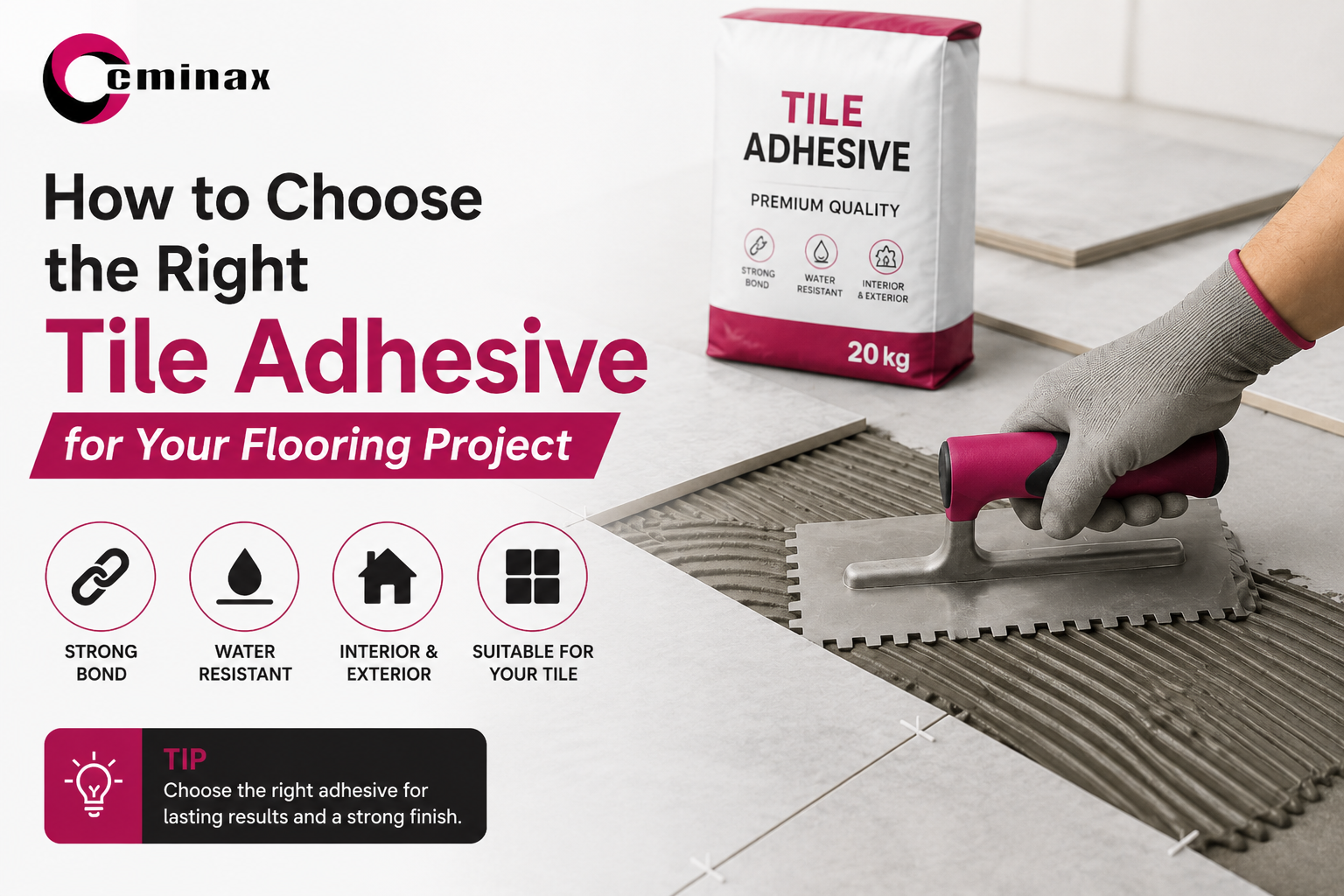
Tile adhesive gets used as a catch-all term for almost anything that sticks flooring to a subfloor, but that’s exactly where a lot of projects go wrong. What actually works depends heavily on the tile format you’re installing, since a product built for one type of flooring can perform poorly, or fail outright, on another.
What Do People Actually Mean by “Tile Adhesive”?
There are really two different product families hiding under that one phrase. Cement-based mortar is built for rigid tile such as ceramic, porcelain, or natural stone, where the adhesive needs to grip a hard, inflexible material to a solid substrate. Dispersion adhesive is a different category entirely, formulated for resilient tile formats like vinyl tile and carpet tile, which flex slightly and bond differently than a rigid ceramic piece.
Treating these as interchangeable is a common, costly mistake. The wrong category can mean poor adhesion, tiles that lift over time, or a bond that never fully cures the way the flooring needs it to.
What’s Different About Adhesive for Carpet Tile?
Carpet tile relies on a textile backing bonding evenly across its full surface area, which is where a dispersion adhesive designed specifically for textile coverings matters. Cemimax A300 is built for exactly this, offering strong thread-formation and reliable adhesion across almost all textile coverings, with good water resistance and high initial tack so the tile grips quickly during installation rather than shifting before it sets.
This matters more in commercial settings than people often expect, where carpet tile gets installed across large floor areas and any inconsistency in bonding shows up as lifting edges or visible seams later on.
What Should You Use for Vinyl Tile or Resilient Flooring?
Vinyl tile behaves differently again, since it’s a plastic-based material rather than a textile one, and it needs an adhesive formulated around that. Cemimax A2000 is designed for bonding plastic floor coverings, including vinyl tile, cushioned vinyl, and rubber flooring, with strong plasticizer resistance that keeps the bond stable even as the material expands and contracts slightly over time.
This plasticizer resistance is worth paying attention to specifically. A dispersion adhesive not designed for vinyl can soften or degrade as the tile’s own plasticizers migrate into the adhesive layer, which is a slow failure that often doesn’t show up until well after installation.
Does the Subfloor Matter as Much as the Tile Itself?
It usually matters more. Even the right adhesive for the tile format won’t perform well over a subfloor that’s uneven, overly absorbent, or holding onto residual moisture. An uneven concrete substrate generally needs a self-leveling compound applied first to create a flat, consistent surface, since asking an adhesive to compensate for an uneven subfloor is asking it to do a job it isn’t designed for.
Absorbent or moisture-prone substrates raise a separate issue. A primer or moisture retarder applied beforehand controls how the subfloor interacts with the adhesive layer above it, which affects both bonding strength and how evenly the adhesive cures. Skipping this step is one of the more common reasons a correctly chosen adhesive still underperforms.
What About Sealing Edges, Joints, or Trims Around Tiled Areas?
Adhesive and sealant solve different problems, even though they sometimes get reached for interchangeably. Ultramax MS Adhesive Sealant is built for sealing perimeter gaps, expansion joints, and trim edges around a finished tiled area, combining the strength of polyurethane with weathering resistance and a shorter cure time than silicone.
It isn’t a substitute for the adhesive that sets the tile itself. Its job is to finish and protect the edges of the installation, not to bond the flooring to the subfloor, and using it for both jobs usually means neither is done as well as it should be.
Does Singapore’s Climate Change Adhesive Make Sense?
Humidity affects more of the process than most people expect before their first tiling project here. High ambient moisture can slow curing times and, more importantly, raise the moisture content of a concrete subfloor well above what a standard dispersion adhesive is designed to bond over. That’s a large part of why moisture testing and a suitable primer matter more in Singapore than they might in a drier climate.
Working time is affected too. Adhesive that stays workable for a set period in a controlled environment can behave differently in a humid site, setting up faster or slower than expected. Following the product’s stated working temperature and open time, rather than assuming it behaves the same everywhere, avoids a lot of avoidable installation problems.
What About Ceramic or Porcelain Tile Specifically?
It’s worth being upfront here: ceramic, porcelain, and natural stone tile generally call for a cement-based tile mortar rather than the dispersion adhesives described above, since rigid tile and resilient tile bond very differently to a substrate. If your project involves ceramic or porcelain specifically, it’s worth confirming with your supplier that you’re looking at a cement-based product suited to that tile type, rather than a resilient-flooring adhesive stretched to cover a job it wasn’t built for.
So How Do You Actually Choose the Right One?
Start with the tile format, not the brand or the price. Carpet tile calls for a textile-specific dispersion adhesive, vinyl and resilient tile call for a plasticizer-resistant one, and the subfloor underneath either one needs its own preparation before adhesive even enters the picture.
If you’re not sure which combination fits your project, get in touch with Cemimax with your tile format, subfloor condition, and the space you’re working with, and we’ll point you to the right product rather than a generic recommendation.