
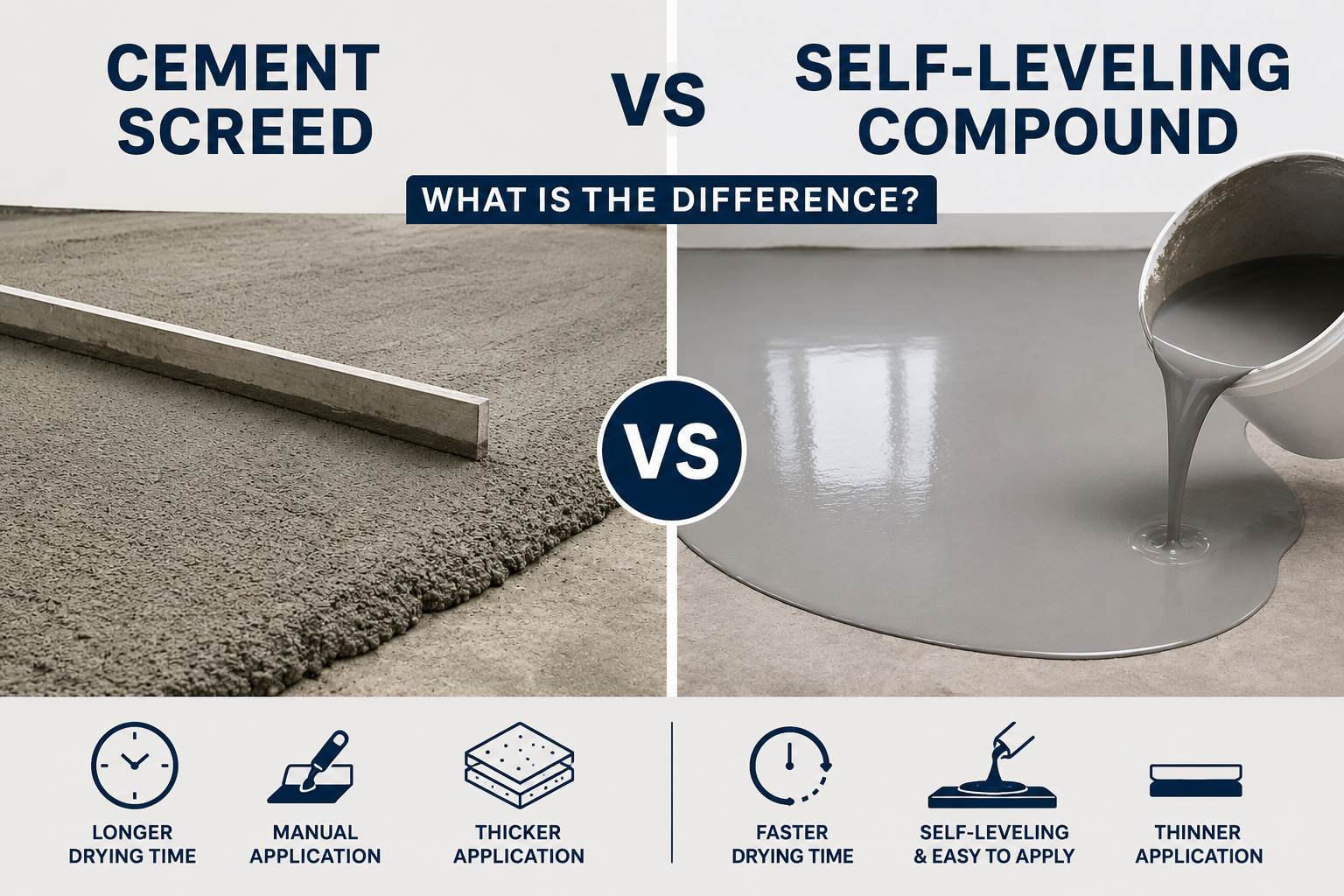
Whether renovating an HDB flat, managing a commercial project, or planning industrial flooring, selecting the right floor preparation method determines your project’s success. Cement screed and self-leveling compound both solve uneven concrete floors, but they work differently and suit different scenarios. This guide helps homeowners, contractors, designers, and architects make informed decisions for Singapore projects.
What Is Cement Screed?
Cement screed is a traditional flooring substrate made from Portland cement, sand, and water. Workers apply it manually using trowels, creating a thick, durable layer over concrete subfloors. It cures through hydration, a chemical process taking weeks for full strength. In Singapore’s humid climate, curing is faster than in temperate regions.
Cement screed comes in three types: bonded (applied directly to concrete, 25–40mm thick), unbonded (over membranes, 40–75mm), and floating (over insulation, over 75mm). Each type serves different structural needs.
What Is Self-Leveling Compound?
Self-leveling compound is a modern pourable underlayment combining cement, polymers, and specialized additives. You pour this liquid mix, and gravity plus chemistry create a perfectly smooth finish without troweling. Most such underlayments reach foot-traffic readiness within 24–48 hours and flooring installation within 3–7 days.
The polymer content in these formulations provides superior moisture resistance and faster strength development compared to traditional screed. This flooring solution is increasingly popular in Singapore for renovations and commercial projects.
For a comprehensive guide on this pourable underlayment, explore our Self Levelling Compound Singapore: The Guide For Smooth And Durable Flooring.
Key Differences
| Aspect | Cement Screed | Self-Leveling Compound |
| Thickness | 25–75mm | 3–6mm |
| Application | Manual troweling (skilled labor) | Poured, self-levels |
| Foot Traffic | 7–10 days | 24–48 hours |
| Final Flooring | 14–21 days | 3–7 days |
| Surface Finish | Textured | Smooth, dense |
| Strength (28 days) | 20–40 MPa | 25–35 MPa |
| Material Cost/m² | SGD 8–15 | SGD 25–45 |
| Labor Cost/m² | SGD 12–20 | SGD 3–5 |
| Total Cost/m² | SGD 20–35 | SGD 28–50 |
| Best For | Large corrections, budgets | Precision, fast timelines |
Material Composition
Cement screed uses Portland cement, graded sand, water, and sometimes fiber reinforcement. Simple, proven materials that do not require sophisticated manufacturing. The cement-to-sand ratio typically ranges from 1:3 to 1:4 by volume.
The polymer-modified underlayment discussed above combines cement with acrylic or polyurethane polymers, flow agents, and plasticizers. These additives enable the self-levelling property and improve moisture resistance. The complex formulation requires precision manufacturing, explaining the higher cost.
Thickness and Coverage
Cement screed works in thicker applications, effectively bridging large substrate variations (50mm+). Its thickness provides structural correction and cost efficiency over expansive areas.
This pourable underlayment works in thin layers (3–6mm), ideal for minor corrections (under 15mm). Multiple coats are possible but uneconomical. For severe unevenness, screed is necessary before a thin smoothing layer is poured on top.
Understanding proper substrate assessment is crucial; discover how right concrete floor preparation improves floor durability and guides material selection.
Drying and Curing
Cement screed achieves foot-traffic readiness after 7–10 days in Singapore’s warm climate, but flooring installation should wait 14–21 days for strength development and moisture reduction. Full cure reaches 28 days.
The polymer-based underlayment allows foot traffic within 24–48 hours and flooring installation within 3–7 days. Some rapid-set products are floor-ready within 24 hours, though standard formulations recommend 48–72 hours.
Surface Finish and Strength
Cement screed produces a textured finish. Even when troweled smooth, some texture remains; this can telegraph through thin flooring materials.
A poured smoothing layer creates an exceptionally smooth, dense surface. The liquid mix naturally levels to uniform smoothness, eliminating substrate imperfections that might show through thin vinyl or polished concrete.
Both materials develop adequate compressive strength (20–40 MPa) for residential and commercial flooring. The polymer content in the pourable option slightly reduces rigidity but improves flexibility in buildings with minor movement.
When to Use Each Material
Use Cement Screed for: Large floor areas needing cost efficiency – Substrate variations exceeding 30mm – Traditional construction workflows – Budget-conscious projects – Industrial or warehouse flooring – New construction sites
Use a Polymer-Modified Smoothing Underlayment for: Renovation projects with tight timelines – Precision finishing requirements – Minor corrections (under 15mm) – Thin flooring materials (luxury vinyl plank, thin tiles) – Commercial retail and office spaces – High-traffic areas requiring superior smoothness
Combined Approach
Many Singapore contractors apply cement screed first, then top-coat with a thin poured underlayment, leveraging each material’s strengths. Screed handles bulk correction economically; the thin topping provides the precision-smooth finish required for thin flooring.
This hybrid method is particularly valuable for: – Large commercial renovations – Historic building restorations with severely uneven concrete – Projects where smoothness and cost control both matter – Industrial facilities requiring corrective substrate plus precise surface
Singapore-Specific Considerations
Residential Projects: A pourable smoothing underlayment suits HDB flats and apartments where timeline matters, spaces are smaller (100–300 m²), and final flooring (luxury vinyl plank, polished concrete) benefits from superior smoothness. Older flats with severe unevenness may need a combination approach with screed underneath.
Commercial Spaces: Modern offices and retail almost universally specify this type of polymer-modified topping. Business continuity is critical; extended downtime has financial cost. Timeline compression adds real value despite higher per-square-meter material cost.
Industrial Flooring: Large warehouse and factory floors typically use cement screed. Cost control is important, areas are extensive (2,000+ m²), and textured finish is acceptable for these environments.
Humid Climate: Singapore’s tropical humidity means cement screed cures faster than in temperate regions (advantageous), but moisture management during cure is critical. Polymer-modified screed mixes improve moisture resistance. A polymer-based pourable topping is inherently better suited to humidity; the polymers resist moisture, and faster cure means less humidity exposure.
Common Mistakes to Avoid
- Underestimating floor unevenness: Measure substrate elevation at multiple points; do not assume uniformity
- Using screed for precision work: Accept textured finish or specify a smooth poured topping instead
- Skipping substrate preparation: Poor cleaning, dust, or residue compromises adhesion for both materials
- Wrong primer selection: The poured underlayment requires appropriate primer; incorrect primers cause failure
- Rushing curing timelines: Fast-set products still need proper cure time; premature flooring causes adhesion failure
- Ignoring substrate moisture: Both materials fail if concrete moisture exceeds 85% RH; test moisture before specification