
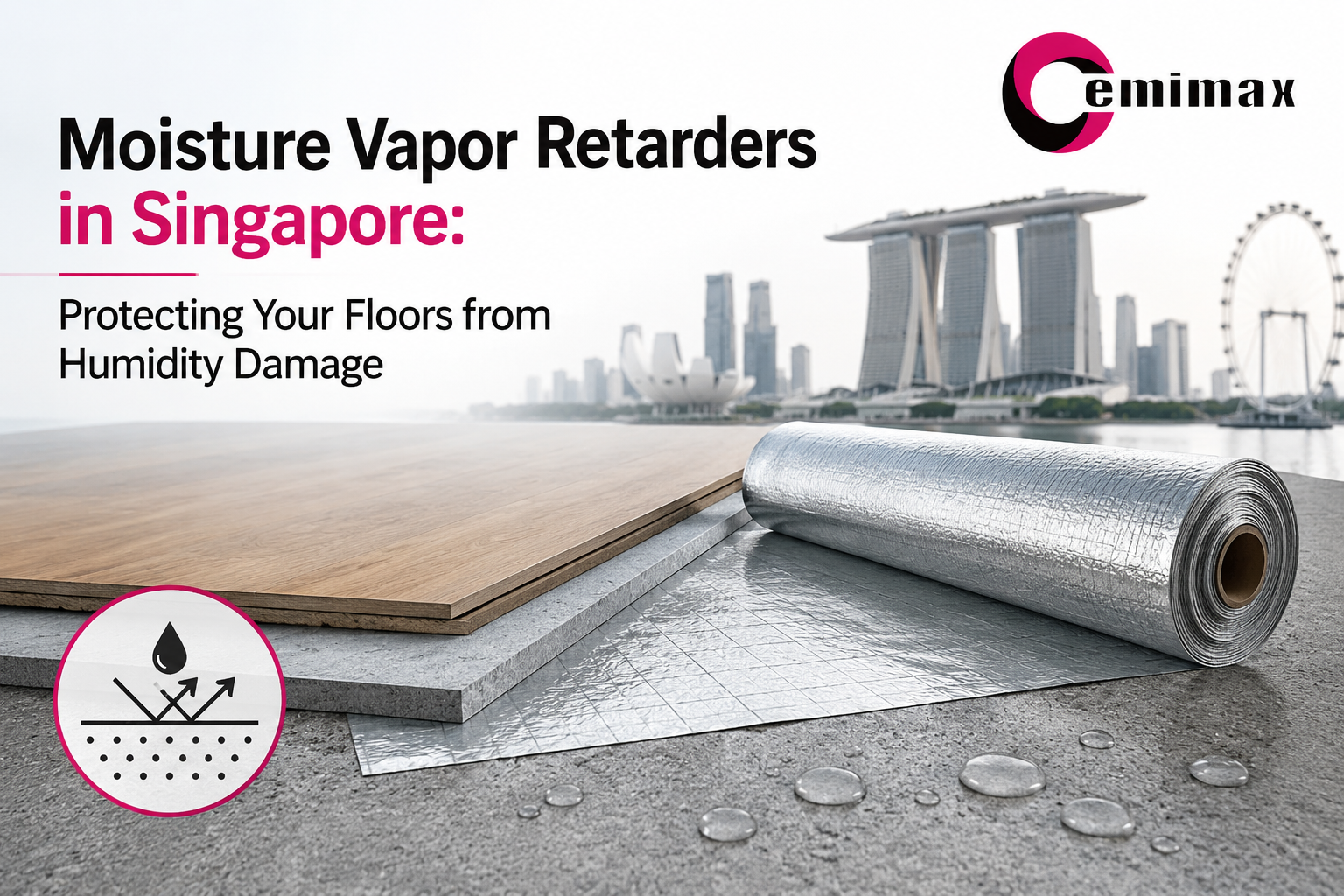
Singapore’s tropical climate doesn’t just affect what happens above your floor it affects what happens underneath it too. Concrete slabs constantly absorb ground moisture, and in a humid environment like Singapore, that moisture has nowhere to go but up. If it isn’t controlled before flooring is installed, the result is often bubbling vinyl, delaminated adhesive, warped timber, or mould growth within months of a brand-new installation.
This is exactly the problem moisture vapor retarders (MVRs) are designed to solve. This guide explains what they are, why they matter in Singapore specifically, and how to choose the right one for your project.
What Is a Moisture Vapor Retarder?
A moisture vapor retarder is a liquid-applied or membrane-based barrier installed directly onto a concrete subfloor. It blocks moisture vapor transmission (MVT) rising from the slab, protecting the adhesives, self-leveling compounds, and finished flooring installed above it.
Unlike a full waterproofing membrane — which is designed to stop liquid water in wet areas like bathrooms — a moisture vapor retarder is specifically engineered to manage vapor emission from concrete, which is a slower, ongoing process that isn’t always visible until damage has already occurred.
Why Singapore Projects Need Moisture Vapor Retarders
- Tropical humidity: Singapore’s average relative humidity often exceeds 80%, increasing the moisture load concrete slabs carry.
- Newer concrete pours: Slabs less than 90–120 days old are still curing and releasing significant residual moisture.
- Below-grade or ground-level slabs: These are in constant contact with soil moisture, especially in older buildings without a modern damp-proof membrane.
- Fast-tracked construction timelines: Flooring is often installed before a slab has fully cured, making an MVR essential rather than optional.
Signs Your Subfloor May Have a Moisture Problem
| Warning Sign | What It Usually Means |
|---|---|
| Bubbling or lifting vinyl | Adhesive breakdown caused by rising moisture vapor |
| Musty smell after installation | Trapped moisture supporting mould growth beneath flooring |
| Discoloured or dark patches on subfloor | Localised moisture concentration in the slab |
| Flooring failure shortly after a new pour | Slab had not cured sufficiently before installation |
| Cupping or warping in timber floors | Moisture absorption through an unprotected subfloor |
Cemimax Moisture Vapor Retarder & Primer Range
Cemimax offers a range of primers and moisture vapor retarders engineered for different subfloor conditions and moisture levels. Choosing the right one depends on your slab’s age, moisture reading, and the flooring system being installed above it.
| Product | Best Suited For |
|---|---|
| Cemimax DP80 Primer | Standard absorbent subfloors requiring reliable bonding before adhesive or compound application |
| Cemimax DP101 Primer | High-performance priming on absorbent subfloors, offering strong bonding and rapid drying |
| Cemimax DP200 Moisture Vapor Retarder | Slabs with elevated moisture vapor emission, including newer pours and below-grade concrete |
For full technical specifications, download the data sheets on the Cemimax Primers & Moisture Retarders product page, which lists application rates, drying times, and compatibility details for each formulation.
How to Choose the Right Moisture Vapor Retarder
- Test the slab first. A calcium chloride or relative humidity (RH) probe test tells you the actual moisture emission rate — never guess based on the slab’s age alone.
- Match the product to the reading. Standard primers are sufficient for low-moisture slabs; higher-emission slabs require a dedicated vapor retarder such as DP200.
- Confirm compatibility with your flooring system. Vinyl, timber, and self-leveling compounds each have different tolerance levels for residual moisture.
- Don’t skip cure time. Even the best moisture vapor retarder needs its specified curing period before the next layer is applied — rushing this step is a common cause of failure.
- Work with a supplier who provides data sheets. Reputable products come with published Technical and Safety Data Sheets — if a product doesn’t have these, that’s a red flag.
Moisture Vapor Retarders vs Waterproofing Membranes
These two products are often confused but solve different problems. A moisture vapor retarder manages vapor rising through a concrete slab from below, while a waterproofing membrane stops liquid water penetration in wet areas such as bathrooms, kitchens, and balconies.
If your project involves wet areas specifically, see our guide on waterproofing membranes to understand how the two systems work together rather than replace one another.
Why Professional Assessment Matters
Moisture-related flooring failures are expensive to fix after the fact — often requiring full removal and reinstallation of the finished floor. Cemimax Asia has supplied primers and moisture vapor retarders to residential, commercial, and healthcare projects across Singapore for more than 25 years, with technical data sheets and safety documentation available for every product to support informed decision-making on-site.
Frequently Asked Questions
Do all concrete floors in Singapore need a moisture vapor retarder?
Not always. It depends on the slab’s age, moisture test results, and the flooring type being installed. A moisture test is the only reliable way to confirm whether one is needed.
How long does a moisture vapor retarder take to cure before flooring can be installed?
This varies by product and site conditions. Always refer to the specific product’s technical data sheet for exact curing times rather than a general rule of thumb.
Can I install a moisture vapor retarder over an old concrete slab?
Yes older slabs can still carry moisture, particularly at ground level. A moisture test is recommended before installation regardless of slab age.
Final Thoughts
Moisture vapor retarders are one of the most overlooked steps in flooring preparation, yet in Singapore’s humid climate, they’re often the difference between a floor that lasts and one that fails within a year. Testing the slab and selecting the right product for the moisture level is a small step that prevents a costly one later.
Need help selecting the right primer or moisture vapor retarder for your project? Contact Cemimax Asia for technical guidance, or explore our full Self-Leveling Compound range to complete your flooring preparation system.