
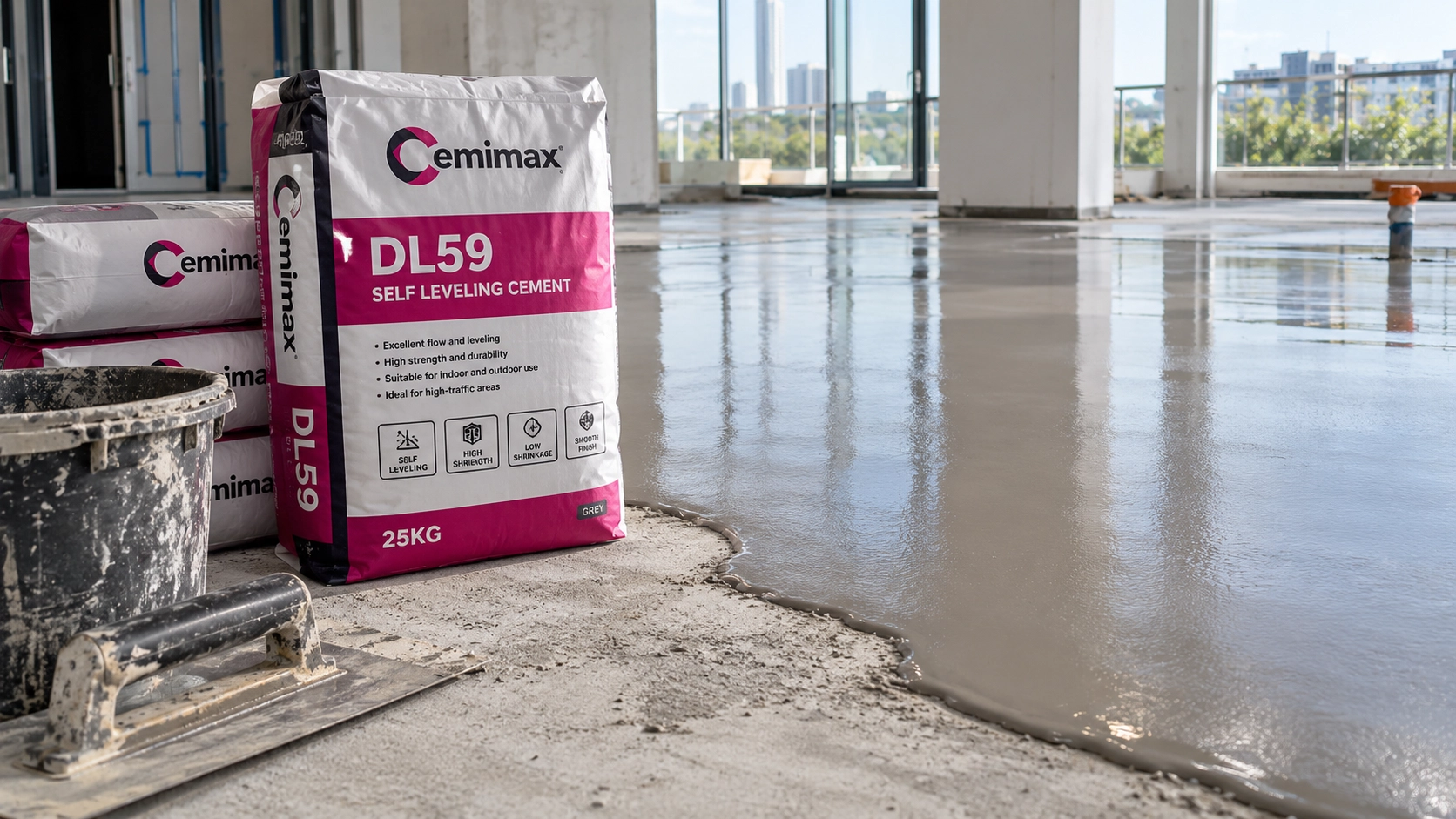
Walk into a busy mall corridor, a hospital ward or a school canteen and look down for a second. That floor takes a beating every day from trolleys, wheelchairs, heels and hundreds of pairs of feet. Whatever sits underneath the finish has to cope with all of it without cracking, dusting or shifting. That is the job Cemimax DL59 was made to handle. It is also the self leveling cement we recommend most often for demanding floors in Singapore.
Contractors and designers ask us about DL59 almost every week. So we have put the most useful answers in one place. If you are comparing high traffic flooring options for a commercial or public project, this guide should save you a few phone calls.
What Is DL59?
DL59 (also sold as LEVEL-DECO DL59) is a high-strength, cement-based self leveling compound. It is made from special hydraulic cements, mineral fillers, graded aggregates and polymer modifiers. Once mixed with water it flows out into a dense, flat layer that hardens quickly and finishes very smooth.
Most levelling products are only meant to sit hidden under a floor covering. DL59 goes a step further. It is strong and smooth enough to be polished, pigmented or used with exposed aggregate, so it can be the finished floor as well as the base for one.
Key Specifications at a Glance
- Application thickness: 1.5 mm to 40 mm
- Compressive strength: around 45 MPa at 28 days
- Flexural strength: around 8 MPa at 28 days
- Working time: 20 to 30 minutes
- Walkable: after about 2 hours
- Coverage: roughly 5 to 6 m² per 20 kg bag at 3 mm
- Mixing water: about 4 litres per 20 kg bag
- VOC level: below 0.5 mg/m³
For context, compressive strength tells you how much load a material can carry before it crushes. A figure in the mid 40s puts DL59 well above typical smoothing compounds. That is why it copes comfortably with pallet trucks, trolleys and constant foot traffic. Its very low VOC level is also a plus for occupied buildings like schools and clinics.
Where DL59 Works Best
- Retail, F&B and logistics floors that see heavy use every day
- Schools, hospitals and public buildings where downtime must be short
- Decorative polished concrete floor overlays
- Direct-stick timber flooring installations
- Radiant floor heating systems
- Balconies, patios and other exterior areas
The 2 hour walkability is a big deal on fast-track fit-outs. Other trades can get back on the floor the same day instead of standing around waiting.
An External Self Levelling Compound Built for Singapore Weather
Most self levelling compounds are strictly for indoor use. DL59 is different. It is suitable for both interior and exterior levelling, which makes it one of the few products we can recommend as an external self levelling compound. Think balconies, patios, covered walkways and building entrances where the same smooth, hard-wearing finish needs to carry on outside.
Outdoor work here comes with its own challenges. Afternoon storms, strong sun and high humidity all affect how a compound cures. A few tips for exterior pours:
- Pour early in the day and check the forecast. Fresh compound must be protected from rain until it has set.
- Shade the area or put up screens so direct sun does not dry the surface too quickly.
- Plan drainage first. Self levelling compounds flow out flat, so any falls for rainwater should be formed in the base or screed beforehand.
- Carry movement joints through the new layer. Outdoor areas see bigger temperature swings than interiors.
- Check with us on the right primer for the substrate before you start.
Why Choose Self Leveling Cement Over Traditional Screed?
Traditional sand and cement screed still has its place, especially for thick build-ups. But hand-laid screed depends heavily on the skill of the person holding the straight edge. It also tends to need a long drying period in our humid climate. A self leveling cement like DL59 flows into place and finds its own level. You get a flatter result with less labour. We covered this in more detail in our article on cement screed vs self-leveling compound.
How to Apply DL59
Good results start well before you open the first bag.
1. Prepare the substrate
The base must be structurally sound, clean, dry and free from cracks. Grind or shot blast away weak laitance, oil and old coatings. Fill cracks and holes first with a suitable patching compound such as Cemimax PP5.
2. Prime
Apply the recommended Cemimax primer and let it dry. On absorbent concrete, DP101 primer controls suction so the compound does not dry out too quickly and lose strength. If the slab is still giving off moisture, talk to us about a moisture vapour retarder first.
3. Mix
Add one 20 kg bag to about 4 litres of clean water. Mix with a paddle mixer until the slurry is smooth and free of lumps. Resist the urge to add extra water to make it flow further. It weakens the surface and can cause dusting later.
4. Pour and spread
Pour in strips and spread with a toothed or gauge rake to the required thickness. Work within the 20 to 30 minute window and keep a wet edge.
5. Spike roll
Go over the surface with a spike roller to release trapped air and blend the strips together.
6. Let it cure
Protect the fresh floor from direct sun, strong drafts and rain during curing. Once dry you can polish it, seal it or install your final floor covering.
A Few Things We Always Tell Contractors
- Order enough bags to finish each area in one continuous pour. Cold joints show up clearly, especially on decorative floors.
- Test a small section first when using pigments so the client can approve the colour before the full pour.
Is DL59 Right for Your Project?
If the floor needs to be strong, fast and good looking, DL59 is usually our first suggestion. For standard interior levelling under vinyl or carpet where heavy loads are not expected, our more economical DL24 Smoothing Compound may suit you better. You can compare the full range in our self leveling compound section or read the DL59 technical data sheet for full details.
Frequently Asked Questions
What is self leveling cement used for?
It is used to create a flat, smooth surface over concrete or screed before flooring goes down. High-strength versions like DL59 can also be polished and left exposed as the finished floor.
How long before I can walk on DL59?
DL59 is walkable after about 2 hours under normal conditions. Allow longer before installing floor coverings or grinding and polishing.
Can DL59 be used outdoors?
Yes. DL59 works as an external self levelling compound as well as an interior one. Protect it from rain and strong sun while it cures and form drainage falls in the base first.
Want a quote or a second opinion on your floor? Contact our team or drop by our warehouse at Lipo Building on Aljunied Road. We are always happy to talk through a floor before you commit to it.