
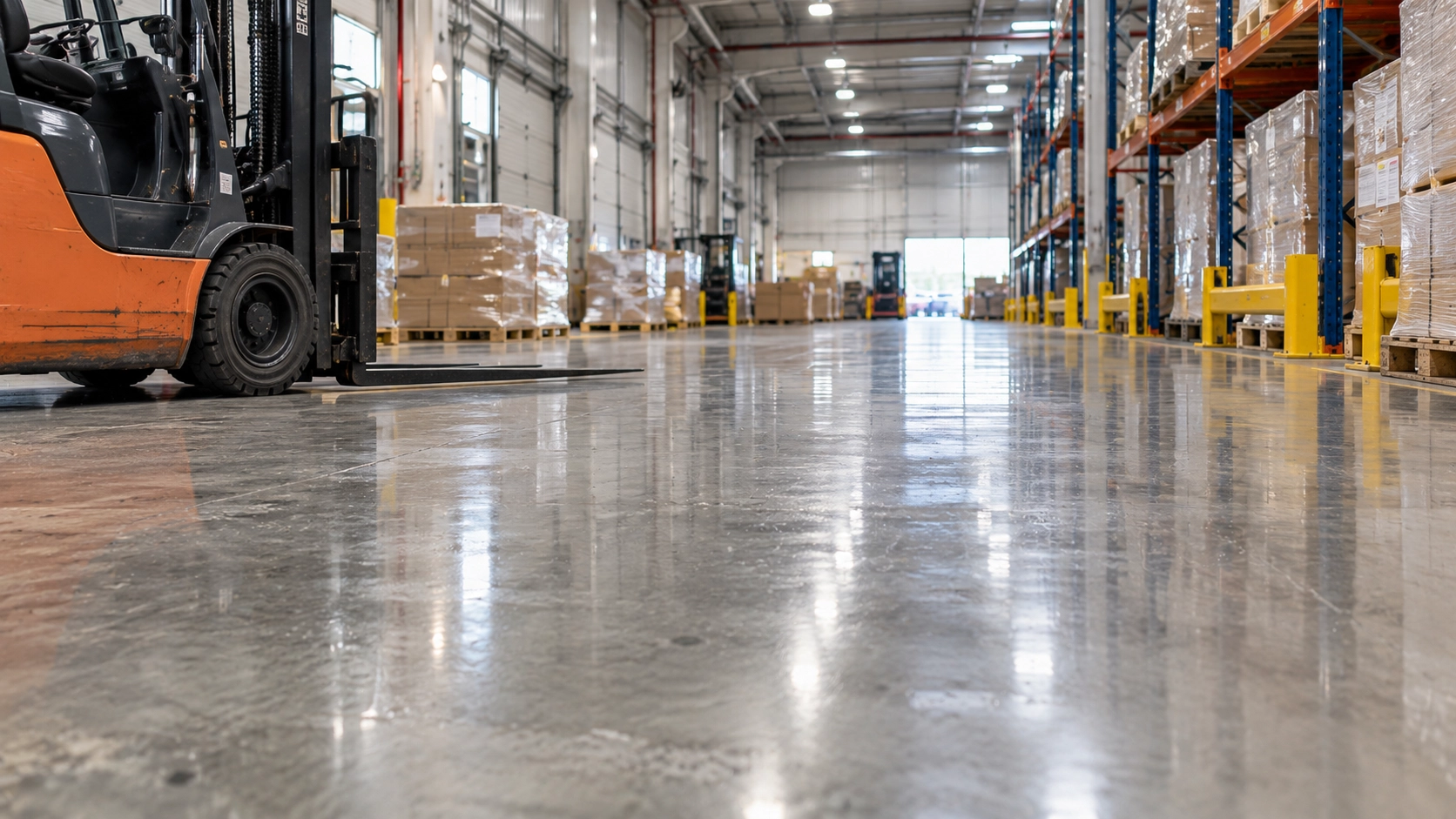
Warehouses, factories, logistics hubs, central kitchens and car park lobbies all share one thing. Their floors work harder than almost any other surface in the building. Pallet jacks, forklifts, trolleys, spills and non-stop foot traffic slowly wear down anything that was not built for the job. Good industrial flooring is what keeps operations running smoothly.
With so many older buildings in Singapore’s industrial estates being upgraded, we get plenty of enquiries about restoring tired floors. This guide covers what makes a good industrial floor and where a high-strength self leveling compound fits in.
What Makes Industrial Flooring Different?
- Load. Wheels from pallet trucks and forklifts put heavy point loads on the surface.
- Abrasion. Constant movement grinds at the top layer, which leads to dusting.
- Impact. Dropped tools and goods chip weak surfaces.
- Downtime. Every hour a floor is closed costs the business money.
- Flatness. Uneven floors slow vehicles down, rattle loads and create trip hazards.
Common Problems on Older Concrete Floors
Many older concrete slabs have been patched again and again over the years. Typical issues with an ageing concrete floor include:
- Surface dusting from weak laitance
- Potholes and spalled joints
- Uneven patches from old repairs or removed machinery
- Oil and chemical contamination
- Cracks that have opened up over time
Breaking out and pouring a new slab is expensive and disruptive. Very often the better option is to repair the existing floor and resurface it.
Where DL59 Comes In
Cemimax DL59 is a high-strength self leveling compound developed for high traffic flooring and heavy-wear areas. It suits warehouse flooring refurbishment for a few reasons:
- Strength. Around 45 MPa compressive strength and 8 MPa flexural strength at 28 days.
- Speed. Walkable in about 2 hours, which helps keep shutdowns short.
- Thickness range. From 1.5 mm to 40 mm, so it handles minor unevenness as well as deeper corrections.
- Flexible finish. It can be polished into a hard-wearing exposed floor or used as a flat base for other systems.
- Indoor or outdoor. It also works as an external self levelling compound for areas like covered loading bays and entrances.
- Pump or manual application. Pumping makes large areas far quicker to complete.
Our DL59 guide goes into the details.
What About Epoxy Flooring?
Epoxy flooring is popular in Singapore for factories, labs and car parks because it creates a seamless, chemical-resistant surface. But an epoxy coating is only a few millimetres thick. It follows the shape of whatever is underneath. If the base is uneven, weak or damp, the coating will show it and may fail early. Any resin system needs a sound, flat substrate, so repair and levelling usually come first. Always check your coating supplier’s substrate requirements before you pour.
Planning an Industrial Floor Refurbishment
- Survey the floor. Map cracks, joints, damaged zones and levels.
- Check moisture. Ground-bearing slabs can carry rising moisture. Consider a moisture vapour retarder where needed.
- Prepare mechanically. Shot blast or grind to remove contamination and weak concrete.
- Repair. Fill potholes and damaged joints. Our patching compound guide covers this step in detail.
- Prime. Use the appropriate Cemimax primer.
- Pour and level. Apply DL59 in planned bays so each area is finished in one continuous pour.
- Respect joints. Carry existing movement joints through the new layer.
- Finish. Polish and seal, or install your chosen floor system once cured.
Safety Comes First
Grinding, mixing and pumping on site carry real risks, from silica dust to heavy lifting. Follow the guidance from MOM on workplace safety and health and read the DL59 safety data sheet before starting.
Frequently Asked Questions
Can DL59 take forklift traffic?
DL59 is designed for high-traffic, heavy-wear areas with around 45 MPa compressive strength. Always assess the specific loads with your engineer or specifier.
Do I need to level before epoxy flooring?
If the base is uneven or damaged, yes. Epoxy coatings are thin and will follow any defects underneath.
How quickly can a warehouse floor reopen?
DL59 is walkable in about 2 hours. Full traffic and further coatings need more curing time, so plan the schedule around the data sheet.
Refurbishing a warehouse or factory floor? Get in touch with Cemimax for product advice and quantities.