
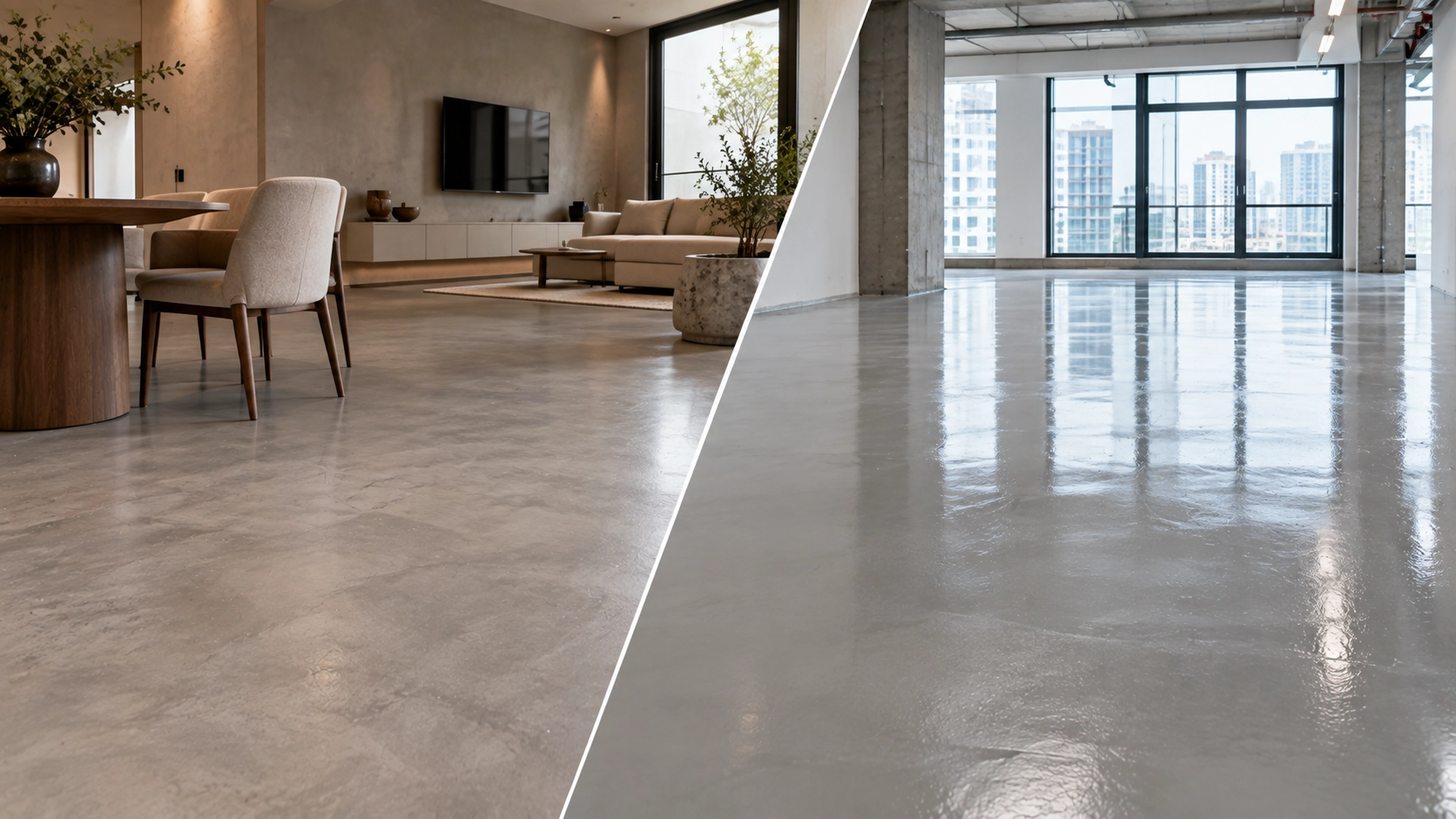
Microcement in Singapore has become one of the most talked about finishes among homeowners and designers. It shows up on floors, walls, bathroom vanities and even staircases. Because it looks similar to other cement-based floors, many people are unsure how it differs from a polished self leveling cement floor.
We work with contractors who install both kinds of finishes. So here is a clear and honest comparison to help you choose.
What Is Microcement?
Micro cement is a thin decorative coating made from cement, polymers and very fine aggregates. It is applied by hand with a trowel in several thin coats and then sealed. The final thickness is usually just a few millimetres. The trowel work gives it that soft, cloudy texture people love.
Because it is so thin, microcement can go over many existing surfaces including tiles. That makes it popular for renovations that want to avoid hacking.
What Is a Self Leveling Cement Floor?
A self leveling cement floor uses a flowable compound that is poured, spreads out on its own and hardens into a dense, flat surface. A high-strength product like Cemimax DL59 can be ground, polished and sealed much like polished concrete. It is laid thicker than microcement, from 1.5 mm up to 40 mm.
Key Differences
| Feature | Microcement | Self leveling cement (DL59) |
|---|---|---|
| Application | Hand-trowelled in several thin coats | Poured, spread and spike rolled |
| Thickness | Very thin, a few millimetres | 1.5 mm to 40 mm |
| Look | Soft, cloudy, hand-crafted texture | Smooth, uniform polished concrete style |
| Levelling ability | Follows the existing surface | Corrects uneven floors |
| Walls and vertical surfaces | Yes | No, floors only |
| Strength | Varies by system | Around 45 MPa compressive strength |
| Time to walk on | Multiple coats with drying in between | About 2 hours after pouring |
When Microcement Makes Sense
- You want the same look on floors and walls, such as in a bathroom
- The existing floor is already flat and sound
- You prefer a textured, artisan feel
- Floor height is tight and you cannot add much thickness
When a Self Leveling Cement Floor Makes More Sense
- The existing floor is uneven and needs correcting anyway
- The area sees heavy traffic, such as a café, shop or office
- You want a smoother, more uniform seamless floor
- You need the space back in use quickly
For more on the polished route, see our article on polished concrete floors. If this is for a home, our guide to cement flooring for Singapore homes covers the practical side of living with it.
The Middle Ground: A Decorative Overlay
If you like a hand-finished cement texture but want a product that belongs to a complete floor system, take a look at Cemimax CemITOP Decorative Overlay. It is designed to create a decorative cement finish over a properly prepared base.
Whatever You Choose, the Base Is Key
Microcement is thin, so it mirrors any unevenness beneath it. Many installers level the floor first with a smoothing compound like DL24 before the decorative coats go on. Cracks in the substrate can also reflect through thin finishes, so repairs and priming should never be rushed.
Frequently Asked Questions
Can microcement be applied over tiles?
In many cases yes, if the tiles are well bonded and properly prepared. Grout lines may need filling first so they do not show through.
Is microcement or polished cement more durable?
A high-strength self leveling cement like DL59 is designed for heavy traffic. Microcement durability varies widely by system and sealer.
Can microcement level an uneven floor?
No. It is too thin to correct unevenness. Level the floor first with a suitable compound.
Comparing seamless finishes for a home or commercial space? Reach out to Cemimax and we will help you work out which system and preparation suit your floor.