
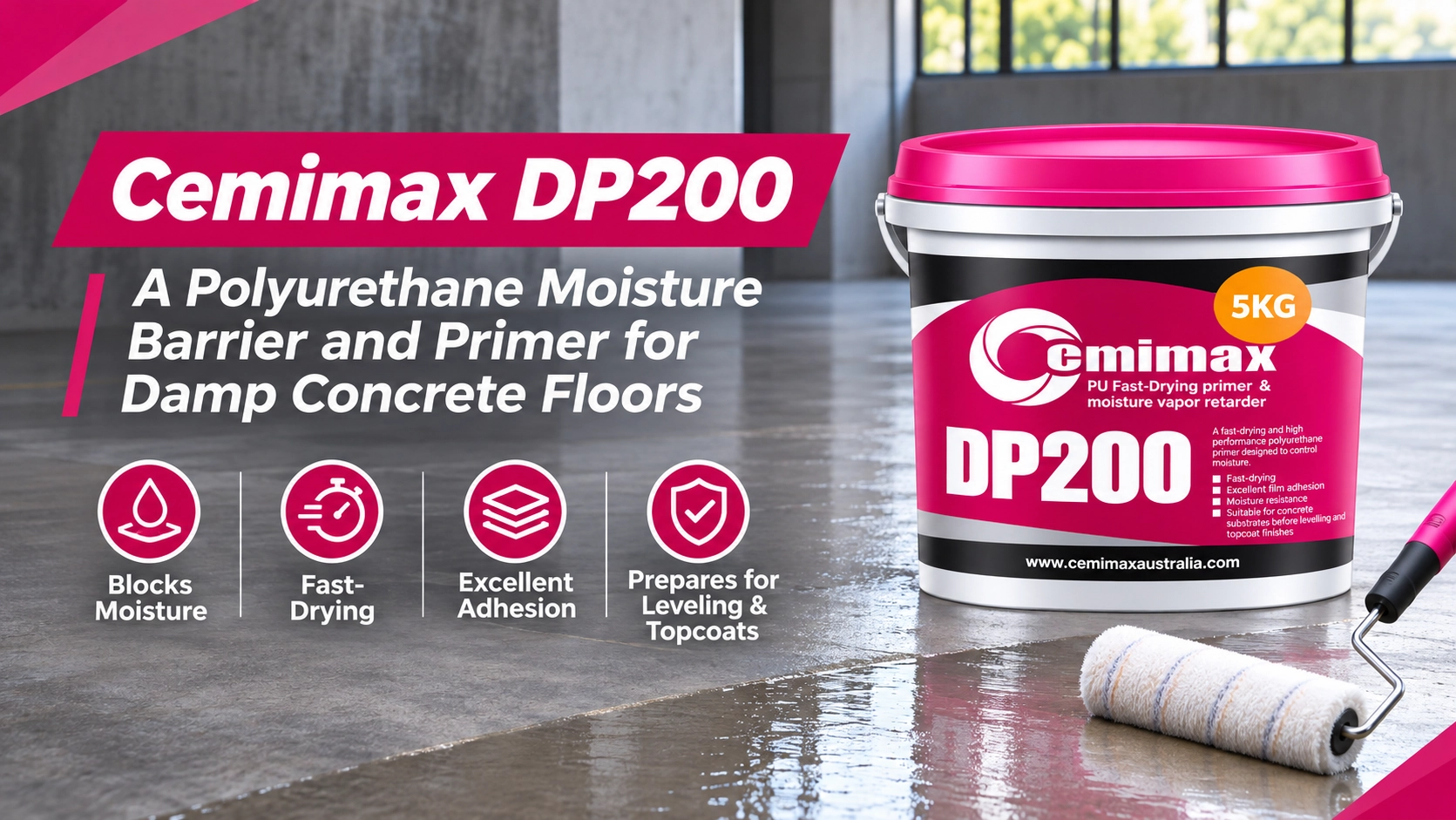
Ask any flooring contractor in Singapore what keeps them up at night and moisture will be near the top of the list. A beautiful vinyl or timber floor can fail within months if the slab underneath is still releasing water. That is exactly why we bring in Cemimax DP200, a one-component polyurethane primer that also works as a moisture barrier for damp concrete floors.
This month we are spending a lot of time on DP200 because it solves a problem we see on site every week. Here is what it does, where it fits and how to use it properly.
What Is DP200?
DP200 is a fast-drying, solvent-free polyurethane primer and moisture vapour retarder. It does two jobs in one product:
- As a primer, it soaks into porous concrete and cement-based subfloors, strengthens the surface and gives levelling compounds and adhesives a firm base to bond to.
- As a moisture barrier, two to three coats form a closed film that holds back moisture vapour rising from the slab.
It can be used on substrates with residual moisture up to 6% CM. That makes it a practical choice for new slabs, ground floor units and renovation jobs where waiting weeks for the floor to dry is simply not an option.
Where DP200 Is Used
- Concrete and cement-based subfloors
- Damp, newly poured or ground floor slabs up to 6% CM
- Ceramic, terrazzo and stone subfloors
- Surfaces with well-bonded, waterproof adhesive or smoothing compound residues
- Priming before a self-levelling compound
- Interior and exterior areas
DP200 Specifications at a Glance
| Property | Value |
|---|---|
| Product type | 1-component polyurethane primer and moisture vapour retarder |
| Consumption as a primer | 100 to 150 g/m² (one coat) |
| Consumption as a moisture barrier | 250 to 350 g/m² in total (two to three coats) |
| Drying time on absorbent surfaces | 40 to 90 minutes per coat |
| Drying time on dense surfaces | 60 to 150 minutes |
| Maximum substrate moisture | Up to 6% CM |
| Pack size | 5 kg and 20 kg buckets |
| Shelf life | 12 months |
A quick way to estimate quantities: one 20 kg bucket covers roughly 130 to 200 m² as a single primer coat. Used as a full moisture barrier at 250 to 350 g/m², the same bucket covers about 57 to 80 m². Always add a margin for rough or very porous slabs.
Why Moisture Matters So Much in Singapore
Concrete holds a lot of water after it is poured and releases it slowly as vapour. In a hot, humid climate like ours that process takes longer than many project schedules allow. When an impermeable floor covering such as vinyl, rubber or sealed timber goes down too early, the vapour gets trapped underneath. The adhesive softens, the floor bubbles or lifts and in the worst cases mould starts to grow.
We wrote about the bigger picture in our article on moisture vapour retarders in Singapore. DP200 is our practical answer when the slab is damp and the programme cannot wait.
How to Apply DP200
1. Prepare the subfloor
The surface must be clean and structurally sound. Grind off loose material, laitance and weak layers, then vacuum thoroughly. Repair cracks and holes first with a suitable patching compound.
2. Stir the bucket
Mix the contents well before you start. No dilution is needed.
3. Roll it on
Apply with a primer roller, velour roller or fine-pored foam roller. Spread it evenly and do not let it pool in low spots.
4. One coat or three?
For priming only, one coat at 100 to 150 g/m² is enough. For moisture control, apply two to three coats in a criss-cross pattern until you reach 250 to 350 g/m² in total. Each coat should form a thin, closed film before the next one goes on.
5. Finish the surface
Broadcast quartz sand (70 to 140 mesh) into the last coat while it is still wet. This gives the next layer a rough surface to key into. If you skip the sand, apply Cemimax DP80 once DP200 has dried.
6. Move on to the next layer
A levelling compound such as DL24 or DL59 can be applied the next day. If you are bonding directly onto DP200, complete that work within 72 hours after the primer has dried.
We will publish a full step-by-step application guide later this month. In the meantime, our post on concrete floor preparation covers the groundwork.
When DP200 Is Not the Answer
DP200 handles residual moisture and vapour. It is not a replacement for proper waterproofing where liquid water is actively seeping through the slab under pressure. If a floor is visibly wet, pooling or leaking, find and fix the source first. Our waterproofing membrane range and a specialist assessment may be needed.
Frequently Asked Questions
Can DP200 be used on a new concrete slab?
Yes. DP200 is designed for damp and newly poured slabs with residual moisture up to 6% CM. Test the slab first so you know which side of that limit you are on.
How many coats of DP200 do I need?
One coat at 100 to 150 g/m² when you only need a primer. Two to three coats totalling 250 to 350 g/m² when you need a moisture barrier.
Can I put self levelling compound straight onto DP200?
Yes, after broadcasting quartz sand into the final wet coat or applying DP80 once it is dry. The levelling compound can then go on the next day.
Dealing with a damp slab on your next project? Read the DP200 technical data sheet for full details or speak with our team and we will help you work out the right build-up and quantities.