
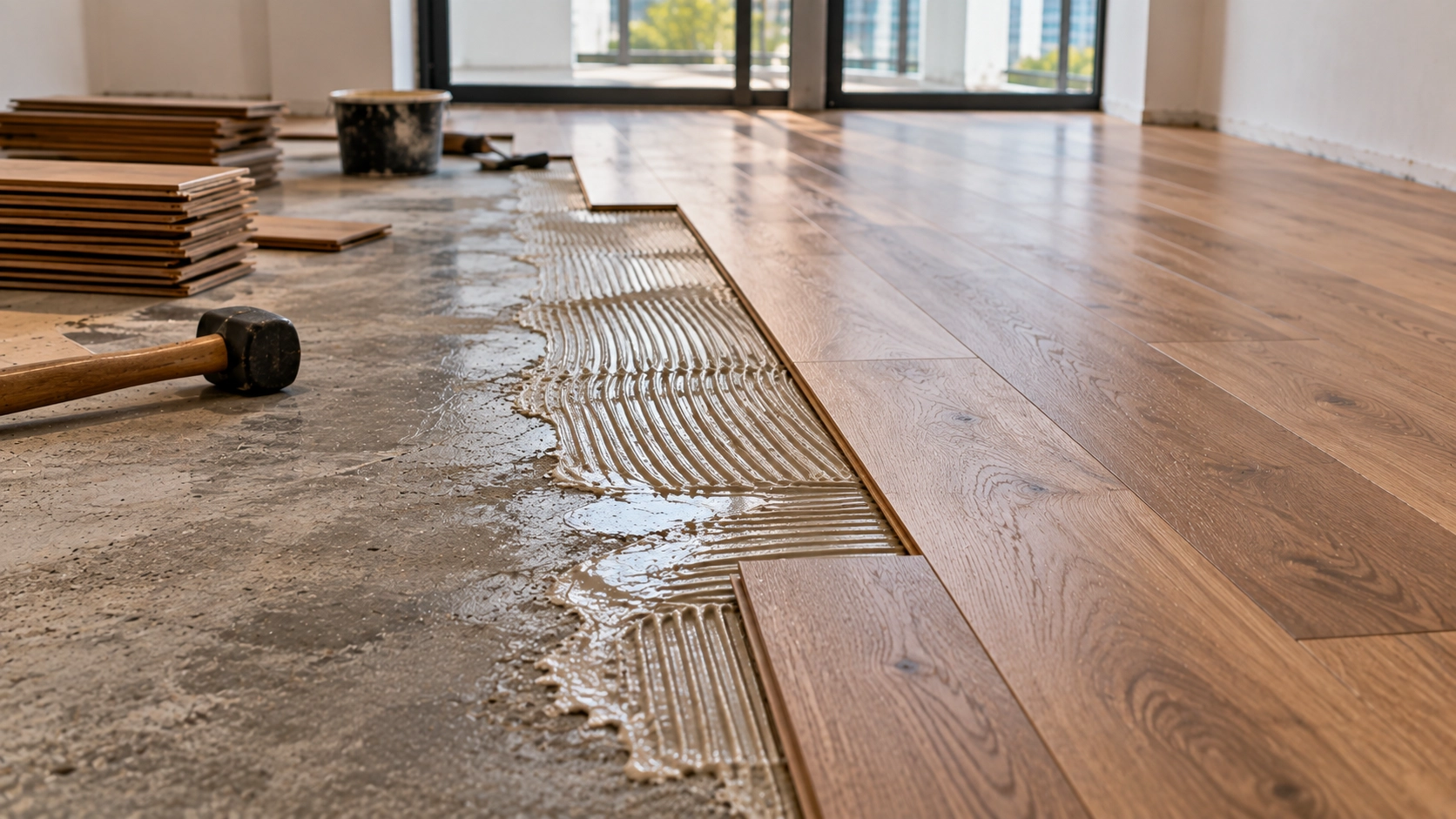
Few things make a home feel warmer than real timber underfoot. Solid and engineered timber flooring in Singapore is still a popular choice for condos, landed homes and boutique offices, even with so many vinyl and SPC options around.
Timber is also one of the least forgiving floor coverings when it comes to what lies underneath. Our humidity, an uneven slab or a damp subfloor can turn an expensive floor into a squeaky, cupping or lifting mess. This guide looks at the part of timber flooring installation that people often rush: the subfloor.
Floating vs Direct-Stick Timber
Floating floors sit on an underlay and are not fixed to the subfloor. They are faster to install but can feel and sound hollow.
Direct stick timber flooring bonds each board to the subfloor with adhesive. It feels more solid, sounds quieter and is often preferred for premium solid timber and engineered wood flooring. Engineered boards in particular, with their layered engineered wood build, bond very well when the base is right. The trade-off is that direct-stick demands a flatter, stronger and drier base.
Why Timber Is So Sensitive in Singapore
Wood naturally absorbs and releases moisture from its surroundings. Singapore’s high relative humidity all year round means timber is constantly reacting to the air. If moisture is also rising from the concrete below, boards can swell unevenly and cup. That is why subfloor moisture control matters so much here.
What a Good Timber Subfloor Needs
- Flatness. Dips leave hollow spots under direct-stick boards and cause creaks.
- Strength. The adhesive transfers stress from the timber into the subfloor. A weak surface can pull apart.
- Dryness. Moisture from the slab is one of the biggest causes of timber failure.
- A clean surface. Dust and contaminants reduce adhesive bond.
Why We Recommend DL59 Under Timber
Cemimax DL59 is specifically suited to direct-stick timber installations. With a compressive strength of around 45 MPa, it gives a hard, dense layer that can take the stresses timber adhesives pass into the subfloor. It levels from 1.5 mm to 40 mm, so subfloor levelling can often be done in a single pour.
DL59 is also compatible with acoustic underlays and radiant floor heating. That makes it useful in multi-storey developments where noise between units is a concern.
For lighter residential areas where the subfloor is already close to flat, DL24 can be used to smooth the surface instead. Our DL24 vs DL59 comparison explains how to choose.
Step-by-Step Subfloor Prep for Timber
- Test for moisture. Do this before anything else. If readings are high, allow more drying time or use a moisture vapour retarder. Our article on moisture vapour retarders in Singapore explains how they work.
- Prepare the surface. Grind away weak layers, old adhesives and contaminants.
- Repair. Fill cracks and holes with a patching compound.
- Prime. Apply the recommended Cemimax primer and let it dry fully.
- Level. Pour DL59, spread with a gauge rake and spike roll.
- Dry thoroughly. Confirm the levelling layer is dry before any glue goes down.
- Acclimatise the timber. Let the boards sit in the room as the timber supplier recommends.
- Install with the right adhesive. Follow the timber and adhesive manufacturers’ instructions. Browse our flooring adhesives for options.
Warning Signs After Installation
- Boards cupping or crowning
- Creaking or hollow sounds in certain spots
- Gaps opening between boards
- Boards lifting at the edges
If these appear soon after installation, the cause is often in the subfloor rather than the timber itself.
Frequently Asked Questions
Can timber flooring be laid directly on concrete?
Yes, with direct-stick installation. The concrete must be flat, strong, clean and dry first.
Why is my timber floor cupping?
Cupping usually points to moisture, often rising from the slab. Test the subfloor and consider a moisture vapour retarder before reinstalling.
Is DL59 suitable for underfloor heating?
Yes. DL59 is compatible with radiant floor heating systems and acoustic underlays.
Planning a timber floor? Talk to Cemimax about preparing your subfloor properly the first time.