
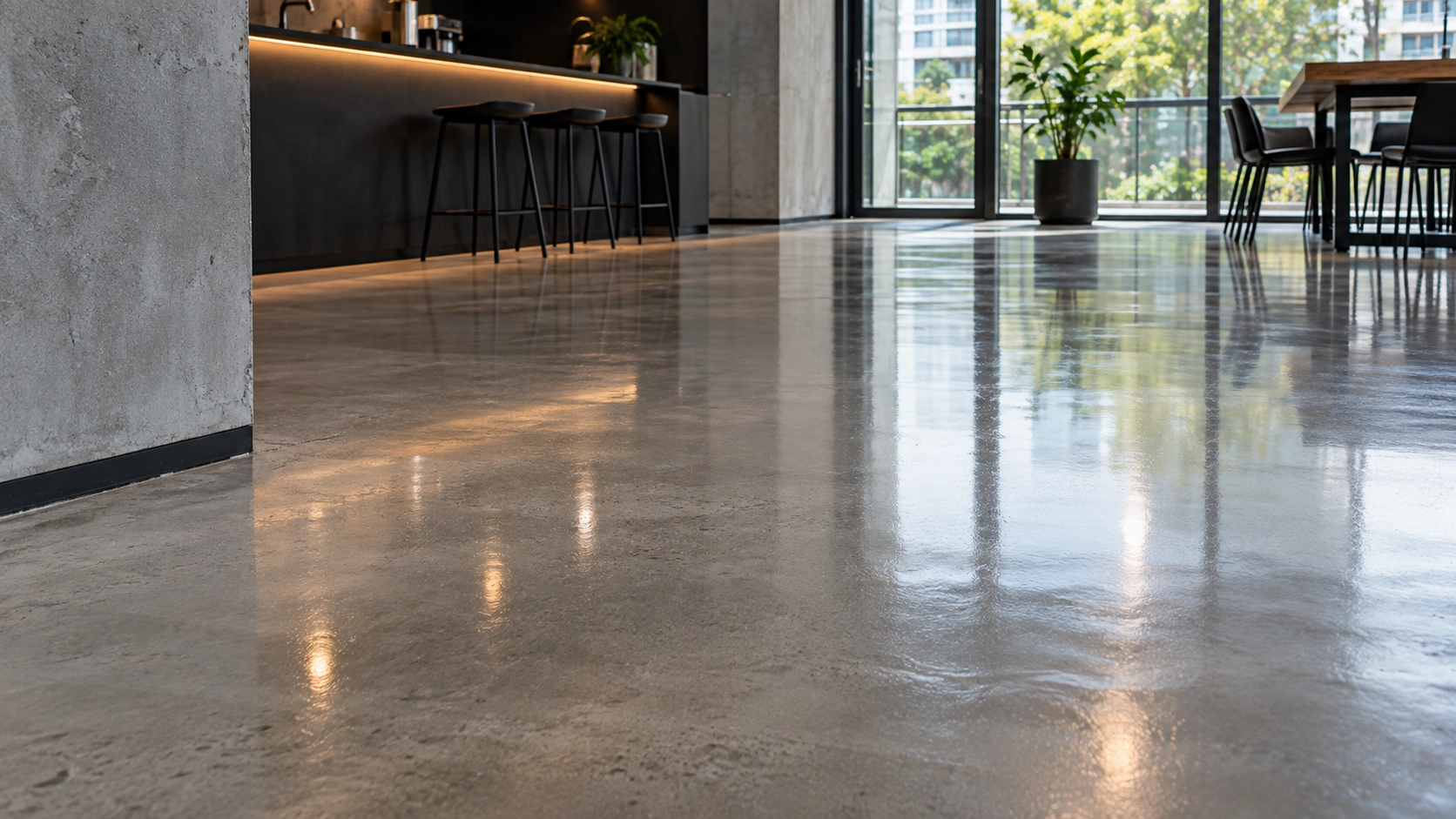
Polished concrete has become a favourite look for cafés, boutiques, offices and even HDB flats and condos around Singapore. It feels clean and modern, it is easy to maintain and it suits almost any interior style. The catch is that most existing slabs are not ready to be polished directly. They are patchy, cracked, stained or simply not flat enough.
That is why many projects now use a self leveling overlay to create a polished concrete floor. Instead of grinding back an old slab and hoping for the best, you pour a fresh, dense layer and polish that. Here is how it works and what to watch out for.
What Is Polished Concrete?
Polished concrete is concrete that has been mechanically ground and honed with progressively finer abrasives until it reaches the sheen you want. It is usually treated with a densifier and a sealer to harden the surface and make it easier to clean. The finish can range from a soft matte to a high gloss.
Why Use an Overlay Instead of the Original Slab?
- Consistent appearance. Old slabs carry years of repairs, stains and different pours. An overlay gives you one even surface.
- Flatness. Polishing highlights every dip. Starting from a self-levelled surface makes the result look far more refined.
- Less aggressive grinding. You avoid grinding through old contaminants and coatings.
- Design flexibility. Pigments or exposed aggregate can be added for a custom decorative overlay.
Why DL59 Suits Polished Finishes
Cemimax DL59 was formulated with decorative work in mind. It reaches a compressive strength of around 45 MPa at 28 days, so the surface is dense enough to grind and polish without breaking up. It also produces a very smooth finish that needs no sanding. It works with pigments and exposed aggregate and can be laid from 1.5 mm up to 40 mm thick.
Because it is walkable in about 2 hours, it is practical for shops and restaurants that need to reopen quickly. You can find the full specs in our DL59 guide.
The Basic Process
- Assess the slab. Check for cracks, moisture and movement joints. Any structural cracking must be dealt with first.
- Prepare mechanically. Grind or shot blast to remove weak surface layers, old adhesives and contaminants.
- Repair and prime. Fill holes with a patching compound and apply the recommended Cemimax primer.
- Pour DL59. Mix each 20 kg bag with about 4 litres of water, pour, spread with a gauge rake and spike roll.
- Cure. Protect the surface from sun, rain and unnecessary foot traffic during early curing.
- Grind and polish. Once cured, work through the abrasive grits to your chosen sheen.
- Densify and seal. Apply a densifier and a suitable sealer to improve stain resistance.
Things to Know Before You Commit
It will not look identical to the mood board. Cement-based floors have natural variation in tone and some gentle clouding. Most people love this character, but it is worth setting expectations with clients early.
Hairline cracks can happen. Cement materials can develop fine cracks over time, especially above existing slab joints. Plan movement joints properly and carry existing ones through the new layer.
Sealing matters in F&B. Oil, soy sauce and coffee can stain an unsealed surface. A good sealer and regular maintenance keep the floor looking good for years.
Always do a sample. Pour a small test area and polish it so everyone agrees on colour and sheen before the full job starts.
Polished Concrete vs Other Cement Looks
If you like the cement look but prefer a thinner, hand-trowelled texture, a finish like Cemimax CemITOP may suit you better. We will compare these options alongside microcement later this month. For an overview of the compounds available locally, read our guide to cementitious floor compounds in Singapore. If you are curious about older seamless finishes, terrazzo is another classic worth comparing.
Frequently Asked Questions
Can you polish a self leveling compound?
Only certain products. DL59 is formulated to be ground and polished. Standard smoothing compounds are too soft for polishing.
Is polished concrete slippery?
A high-gloss finish can feel slippery when wet. A lower sheen or an anti-slip sealer helps in kitchens, entrances and wet areas.
How long does a polished concrete floor last?
With proper sealing and regular cleaning, a well-installed polished floor can last many years. Resealing from time to time keeps it looking good.
Planning a polished floor for a shop, office or home? Talk to our team about your space and we will recommend the right build-up.