
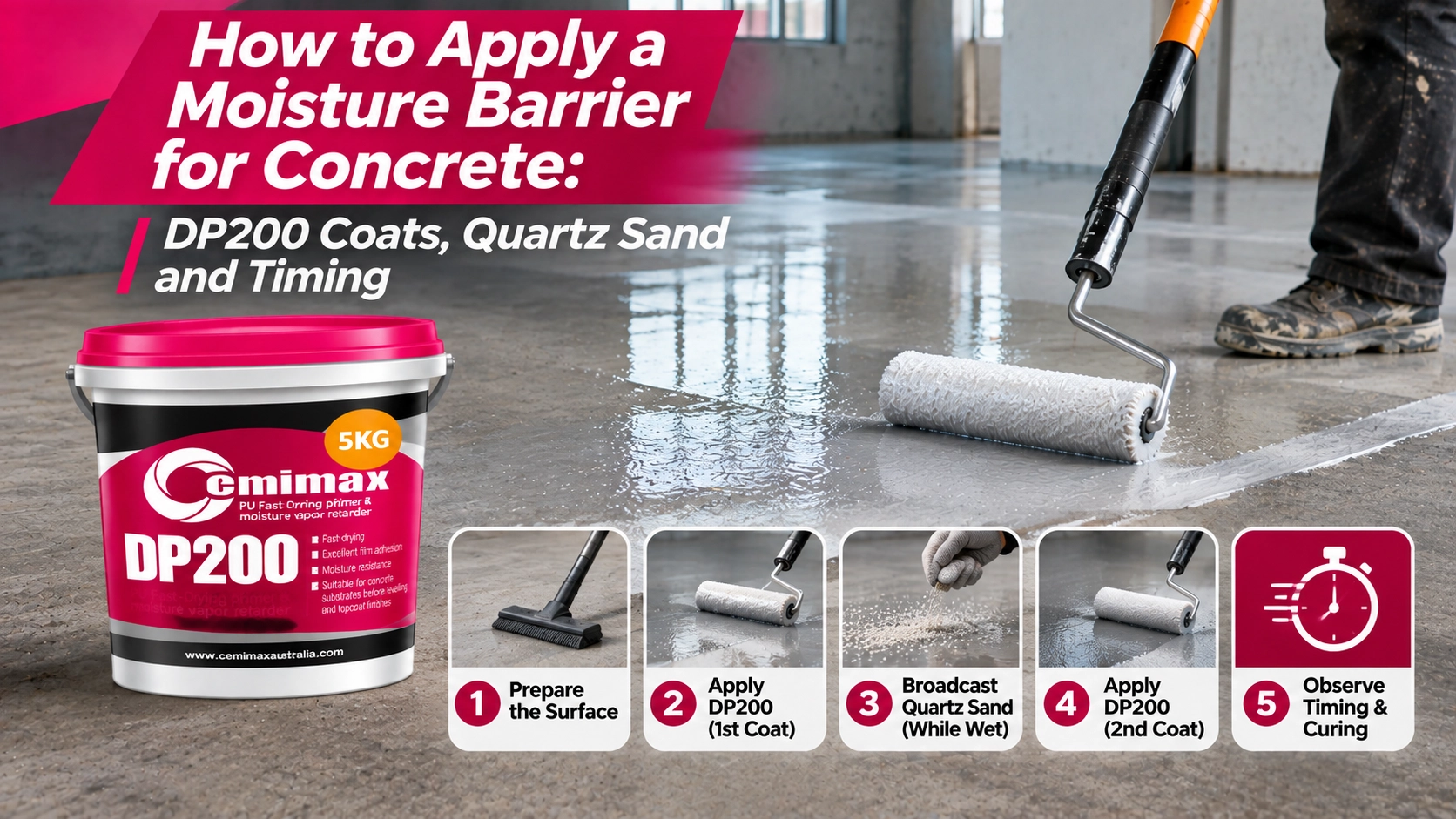
A moisture barrier for concrete only works if it is applied properly. Missed spots, thin coats or rushing the next layer can all let moisture back in. After a month of articles on why slab moisture matters, here is the practical side. This is how to apply moisture barrier coats properly using Cemimax DP200 as a moisture vapour retarder.
Before You Start
Check these boxes first:
- The slab has been tested and the reading is no higher than 6% CM. Our guide on checking a concrete slab explains how.
- There is no active water seepage. If there is, fix that first. See our article on water seepage through ground floor slabs.
- You have the technical data sheet and safety data sheet on hand.
- Ventilation is planned and the team has suitable gloves and protective gear. MOM workplace safety guidance applies on every site.
What You Will Need
- DP200 in 5 kg or 20 kg buckets
- Primer roller, velour roller or fine-pored foam roller
- Brush for edges and corners
- Kiln-dried quartz sand, 70 to 140 mesh
- Industrial vacuum
Working Out Quantities
As a moisture barrier, DP200 is applied at 250 to 350 g/m² in total across two to three coats. For a 50 m² ground floor living area:
- At 250 g/m²: 50 × 0.25 = 12.5 kg
- At 350 g/m²: 50 × 0.35 = 17.5 kg
So one 20 kg bucket would cover that room with a small margin. Very porous or rough slabs will sit at the higher end.
Step-by-Step Application
Step 1: Prepare the surface
Grind the slab to remove laitance, old adhesive, paint and any weak material. The surface must be clean and structurally sound. Vacuum thoroughly. Fill cracks and holes with a suitable patching compound and let them cure.
Step 2: Stir well
Stir the bucket thoroughly before use. DP200 is ready to use with no dilution.
Step 3: First coat
Roll the first coat evenly across the slab. Work it into the surface and avoid puddles in low spots. Cut in around edges and penetrations with a brush.
Step 4: Let it dry
Allow 40 to 90 minutes per coat on absorbent surfaces and 60 to 150 minutes on dense surfaces. Drying varies with temperature and airflow, so check the surface rather than relying on the clock.
Step 5: Second coat, criss-cross
Apply the second coat at right angles to the first. This criss-cross pattern helps cover any tiny gaps and builds a closed film. Look across the floor with a torch at a low angle to spot dull or missed areas.
Step 6: Third coat if needed
On very porous slabs or readings close to the limit, a third coat helps you reach the full 250 to 350 g/m² and a continuous film.
Step 7: Broadcast quartz sand
While the final coat is still wet, broadcast quartz sand evenly over the surface. Once dry, sweep or vacuum off loose sand. The bonded sand gives the levelling compound a rough surface to grip. If you do not use sand, apply DP80 once DP200 has dried.
Step 8: Next layer timing
Self levelling compound such as DL24 or DL59 can be applied the next day. If you are bonding directly onto DP200, finish that work within 72 hours after the primer has dried.
Common Mistakes to Avoid
- Applying one heavy coat instead of several thin ones
- Leaving pools that cure slowly and unevenly
- Skipping the sand or DP80, which leaves a surface that levelling compound cannot grip
- Walking on the wet film or letting dust settle on it
- Waiting too long before bonding directly onto it
Frequently Asked Questions
How many coats of moisture barrier do I need on concrete?
For DP200, two to three coats totalling 250 to 350 g/m². One coat is only enough when it is used as a primer.
Why do I need quartz sand on a moisture barrier?
The cured film is smooth and dense. Quartz sand gives the next layer a rough surface to bond to.
How soon can I pour self levelling compound after DP200?
The next day, once the moisture barrier is finished with quartz sand or DP80.
Planning to apply DP200 on your next job? Contact our team for quantities or a quick check of your build-up before you start.