
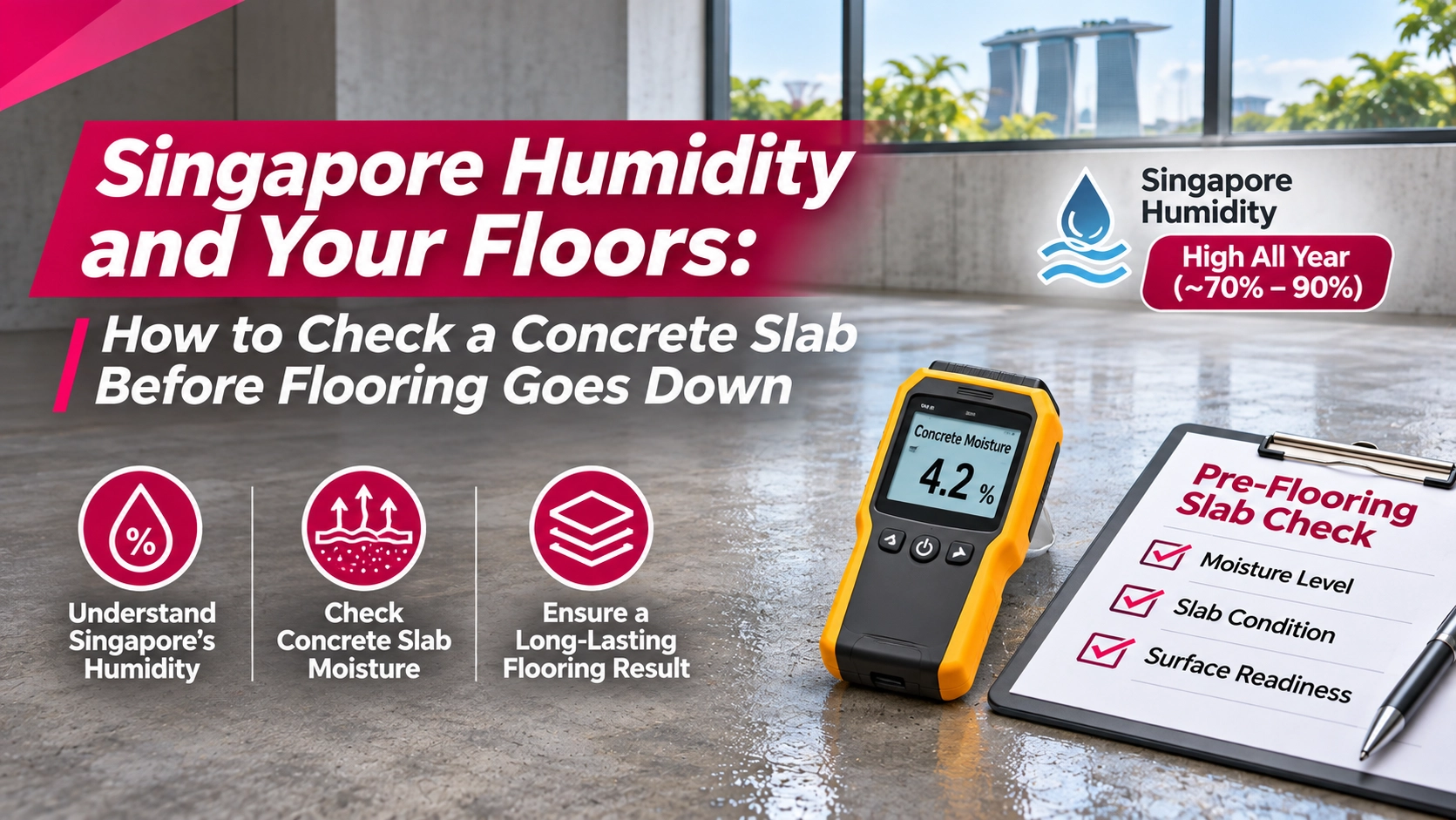
Anyone who has lived here knows the feeling of stepping outside into thick, heavy air. Singapore humidity stays high all year round. That is uncomfortable for people, but it is also a real headache for floors. A concrete slab that would dry in a few weeks in a cooler, drier country can take much longer here.
Laying flooring on a slab that is still releasing moisture is one of the most common reasons floors fail. So how do you know when a slab is ready? Here is a practical guide.
Why Slabs Dry Slowly Here
Fresh concrete and cement screed contain far more water than is needed to set. The extra water slowly makes its way to the surface and evaporates. How fast that happens depends on thickness, ventilation, temperature and the moisture already in the surrounding air. When relative humidity is high, the air simply cannot take on moisture as quickly, so drying slows down.
A rough rule of thumb often quoted for traditional screed is about one day per millimetre for the first 40 mm under good conditions. Thicker layers take longer and poor airflow or high humidity stretches that further. Concrete curing time and drying time are also two different things. A slab may be strong enough to walk on long before it is dry enough for flooring. Treat any rule of thumb as a starting point, never a replacement for a proper concrete moisture test.
Common Ways to Test a Slab
Plastic sheet test
Tape a square of clear plastic tightly onto the slab and leave it for a day or two. Condensation under the sheet or a darker patch of concrete means moisture is coming up. It is a quick screening check but it does not give you a number.
Electronic moisture meters
Handheld meters give a fast reading of surface moisture. They are useful for spotting wet zones across a large floor but they only read the top layer. Use them to decide where to do more accurate tests.
CM test (calcium carbide method)
The CM test is widely used for screeds and slabs before flooring. A sample is drilled out, sealed in a pressure flask with calcium carbide and shaken. The reaction with the moisture in the sample creates gas pressure that converts to a moisture percentage, shown as % CM. It gives a reliable number that flooring and primer manufacturers often refer to.
In-situ relative humidity probes
A probe is placed in a hole drilled into the slab and left to stabilise before reading the relative humidity inside the concrete. This method is common on larger commercial projects.
What Do the Numbers Mean?
Every floor covering and adhesive has its own moisture limit. Many manufacturers set fairly low limits for laying impermeable coverings directly on cement screeds, often around 2% CM. Always check the data sheets for the exact products you are using.
We touched on this in our earlier article on moisture vapour retarders in Singapore. If your concrete moisture test comes back too high, you have two options. Wait longer and keep testing, or use a moisture barrier rated for the reading you have. Cemimax DP200 can be applied on substrates with up to 6% CM. Applied as two to three coats, it holds back rising vapour so flooring can go down without a long wait. Our DP200 guide explains how it works and the technical data sheet has the full figures. If you are laying traditional screed, our guide to screed explains the different types.
Tips for Faster, Safer Drying
- Keep windows and doors open where security and weather allow so air can move.
- Use fans and dehumidifiers in enclosed spaces.
- Avoid covering the slab with stored materials that trap moisture.
- Do not rely on air conditioning alone. It cools the room but can create condensation on cold surfaces.
- Test in several spots, especially near external walls, wet areas and ground floor zones.
Do Not Forget the Damp Floor Hotspots
Some areas stay damp far longer than the rest of the slab. Ground floor units, rooms next to bathrooms and areas below planter boxes are common trouble spots. A single damp floor patch can ruin an otherwise perfect installation, so pay extra attention to these zones. If water is actively seeping rather than slowly drying, that needs to be fixed at the source before any moisture barrier is considered.
Frequently Asked Questions
How long does a concrete slab take to dry in Singapore?
It depends on thickness, ventilation and weather. Thick slabs can take many weeks or months. Always test rather than rely on a calendar date.
What is a CM test?
It is a calcium carbide moisture test. A drilled sample reacts with calcium carbide in a sealed flask and the pressure is converted into a moisture percentage.
What can I do if the slab is still too wet?
Wait and retest, or apply a moisture barrier suitable for the reading. DP200 is designed for substrates with up to 6% CM.
Not sure whether your slab is ready? Talk to our team before you commit to a floor covering. A few minutes of testing can save months of headaches.