
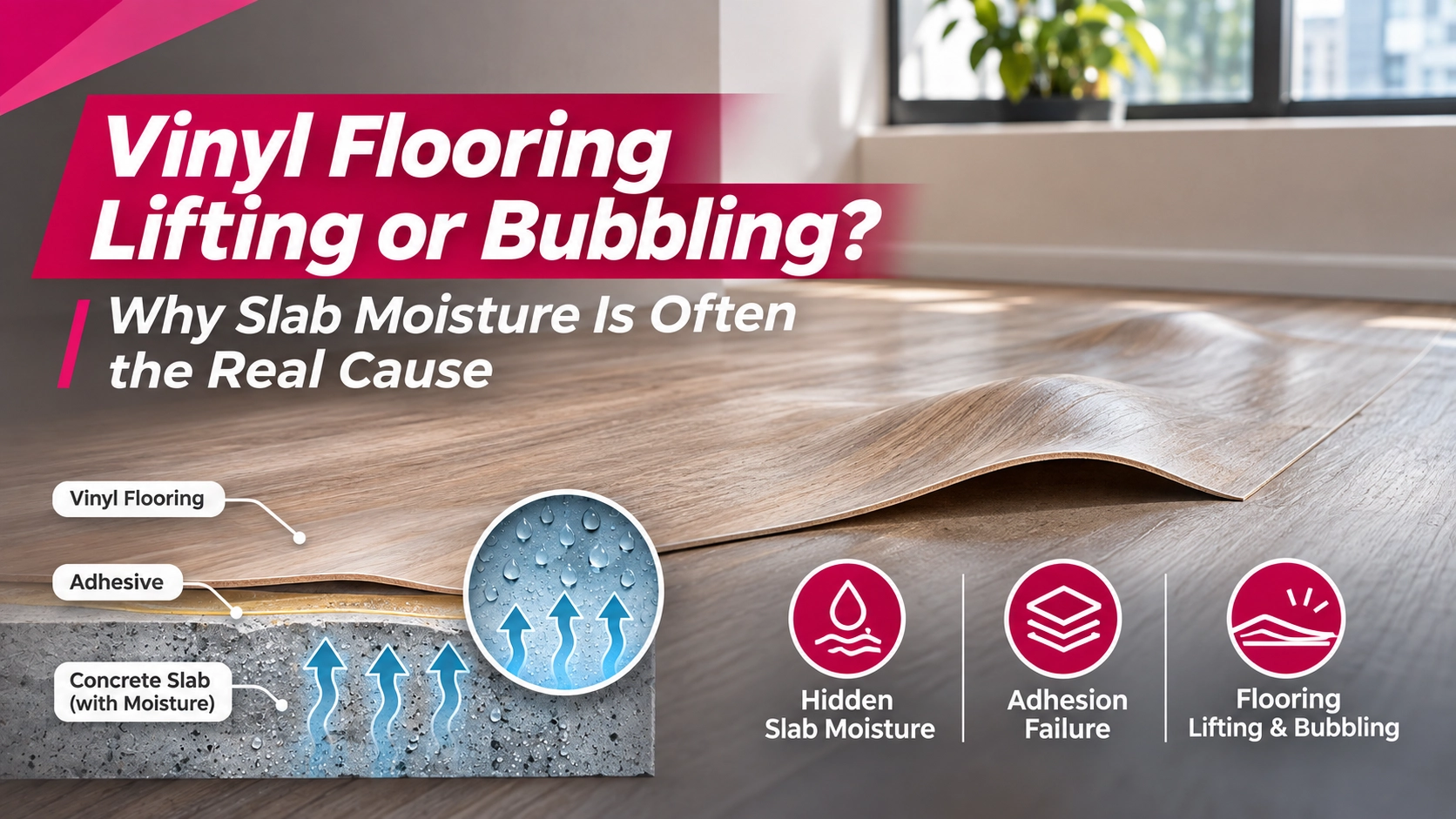
Vinyl flooring is one of the most popular choices for Singapore homes and offices. It looks great, it is quiet underfoot and it costs less than most alternatives. But every week we hear from homeowners and contractors whose glue-down vinyl has started to lift at the edges, form bubbles or come loose in patches. In many of those cases, the vinyl was never the problem. The slab underneath was simply too wet.
How Moisture Ruins a Vinyl Floor
A concrete slab is never completely dry. After it is poured it keeps releasing water as vapour for weeks or even months. Ground floor slabs can also draw moisture up from the ground below through capillary action.
Vinyl is an impermeable floor covering. Once it is glued down, that vapour has nowhere to go. It collects under the surface and starts to attack the adhesive. Over time the bond weakens and you start to see the classic signs of trouble.
Warning Signs to Look Out For
- Vinyl floor lifting at the edges or along plank joints
- Vinyl flooring bubbling or blistering in the middle of the room
- Adhesive oozing up through the seams
- A musty smell or dark marks near walls
- White powdery deposits on the slab when you lift a plank, a sign of efflorescence
If several of these appear within the first few months, slab moisture should be your first suspect.
Other Common Causes
To be fair, moisture is not the only reason vinyl fails. Before you blame the slab, rule these out too:
- Using the wrong adhesive or not following its open time
- Laying over a dusty, weak or uneven subfloor
- Strong direct sunlight heating the vinyl near large windows
- Skipping the primer so the adhesive never bonded properly
Our earlier guide on SPC and vinyl subfloor preparation covers the flatness and preparation side in more detail.
Vinyl Flooring in HDB Renovations
Vinyl flooring HDB jobs often go over existing floor tiles, especially in older flats. Tiles themselves are not the issue. The trouble starts when the screed or slab beneath those tiles is holding moisture, or when ground floor units sit on slabs that stay damp all year. Wet areas next to kitchens and bathrooms can also feed moisture into nearby floors over time.
How to Prevent It
Test before you lay
Never assume a slab is dry just because it looks dry. Test it. A CM test or in-situ humidity probe gives you a proper number to work with. We will cover the testing methods in more detail later this month.
Use a moisture barrier for concrete when needed
If the slab is still damp, a moisture barrier holds back the vapour so the adhesive can do its job. Cemimax DP200 can be used on substrates with residual moisture up to 6% CM. Two to three coats totalling 250 to 350 g/m² form a closed film over the slab. Our DP200 guide has the full details.
Level and smooth
Once the barrier is in place and finished with quartz sand or a coat of DP80, apply a smoothing compound such as DL24 so thin vinyl sits on a perfectly flat surface.
Choose the right adhesive
Pick an adhesive that suits your vinyl product and follow its open time and trowel notch exactly. Browse our adhesives and sealants for options.
Can a Failed Vinyl Floor Be Saved?
Sometimes a small area can be re-glued if the cause was local. If moisture is coming through the whole slab though, re-gluing only buys time. The proper fix is usually to lift the vinyl, clean off the old adhesive, let the slab dry where possible, apply a moisture barrier and then relay. It is more work up front but far cheaper than replacing the floor twice.
Frequently Asked Questions
Why is my new vinyl flooring bubbling?
Trapped moisture vapour from the slab is a common cause. Other causes include the wrong adhesive, poor primer use and heat from direct sunlight.
Do I need a moisture barrier under vinyl flooring?
If the slab tests above the limit set by your vinyl or adhesive manufacturer, yes. Ground floor and newly poured slabs are the most likely to need one.
Can vinyl be laid over tiles in an HDB flat?
Often yes, if the tiles are well bonded and the surface is flat and dry. A suitable primer and a thin smoothing layer usually come first.
Seeing lifting or bubbles in a vinyl floor? Contact Cemimax with photos and a few details about the slab. We are happy to help you figure out the cause before you spend money on the fix.