
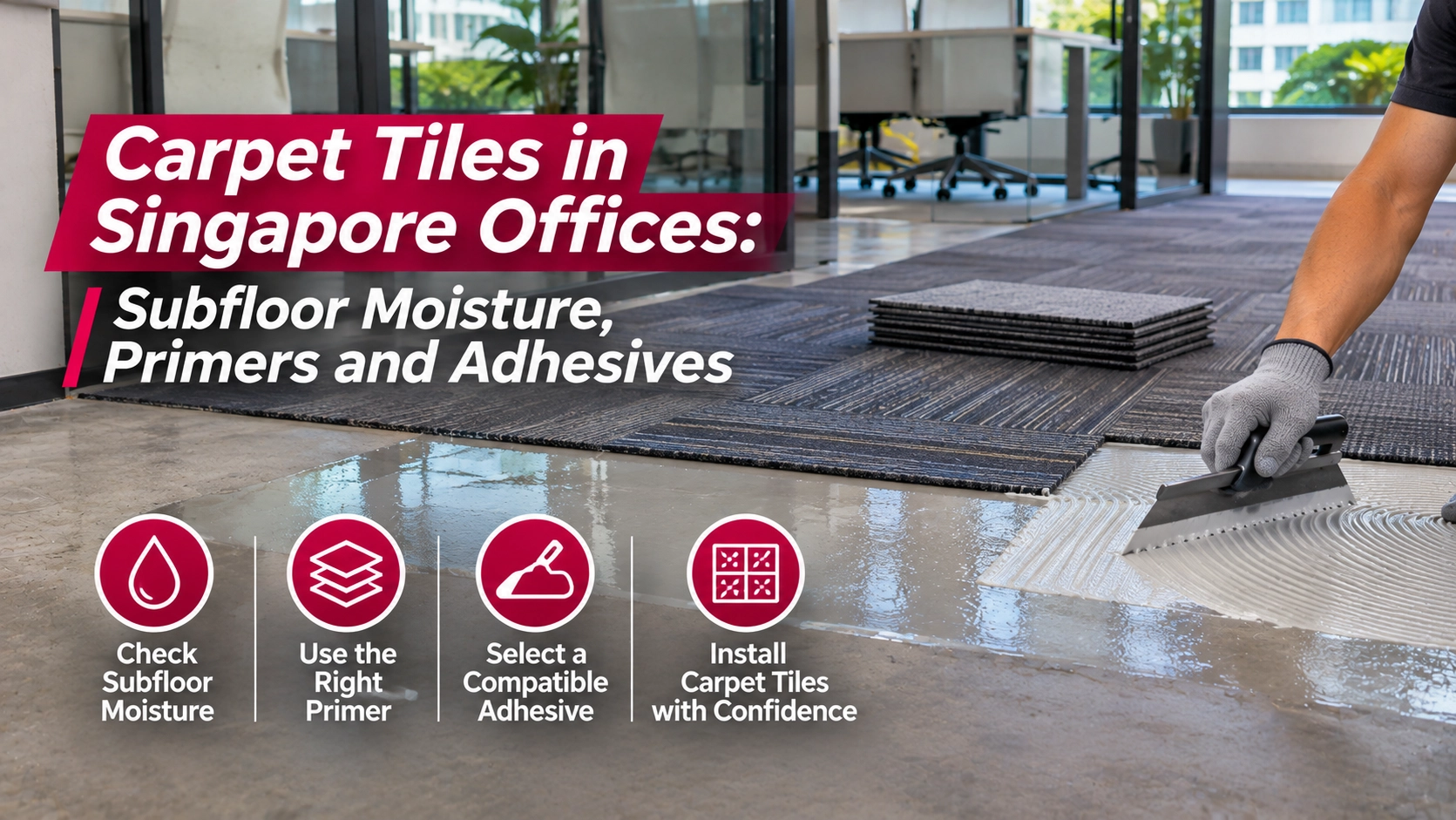
Carpet tiles are a favourite for office flooring in Singapore. They soften noise in open-plan spaces, come in endless colours and patterns and can be swapped out one tile at a time when something gets stained. But carpet tiles in Singapore offices are only as good as what sits beneath them. Moisture, dust and the wrong adhesive can cause curling edges, shifting tiles and smells that are hard to get rid of.
To round off our month on moisture control, here is what fit-out teams should think about before the first box of tiles is opened.
Why the Subfloor Matters for Carpet Tiles
Carpet tiles have a heavy backing that keeps them flat. When moisture comes up from the slab, it gets trapped under that backing. The adhesive weakens, tiles can start to move or curl and damp conditions encourage mould growth. Uneven floors also show through as visible ridges, especially under long rows of tiles.
Watch Out for New Slabs in Fast-Track Fit-Outs
Office fit-out programmes are tight. In new buildings or after major works, carpet often goes down on a new concrete slab or screed that has not had enough time to dry. Add Singapore humidity and air conditioning that has only just been switched on and you have a recipe for trapped moisture.
Testing the slab before installation is essential. If readings are above the limits set by the carpet and adhesive manufacturers, either wait or use a moisture barrier. Cemimax DP200 can be applied on substrates with up to 6% CM. In two to three coats it forms a closed film that holds back rising vapour. That can save days or weeks on a tight programme. Our DP200 guide has the details.
A Reliable Build-Up for Carpet Tiles
1. Prepare the slab
Grind off laitance, old adhesive and paint spots. Vacuum thoroughly. Repair cracks and damaged areas with a patching compound.
2. Prime
For a dry, absorbent slab, use DP101. For a damp slab, use DP200 as a moisture barrier and finish with quartz sand or DP80. Our floor primer guide explains how to choose.
3. Level
A thin layer of DL24 smoothing compound evens out the surface so carpet tiles sit flat and seams line up neatly. Our DL24 guide covers coverage and drying.
4. Choose the right carpet tile adhesive
Most carpet tiles are installed with a pressure-sensitive tackifier so individual tiles can be lifted and replaced later. Broadloom carpet and some textile coverings need a permanent adhesive instead. Cemimax A300 is a low-emission dispersion adhesive for textile coverings. Always follow the carpet manufacturer’s recommendation and check our adhesives range for options.
5. Install and acclimatise
Let the tiles sit in the space at operating temperature before installation. Follow the laying pattern recommended by the manufacturer and keep the work area clean.
Quick Checklist for Fit-Out Teams
- Slab moisture tested and recorded
- Moisture barrier applied if readings are high
- Correct primer used for the substrate
- Smoothing compound fully dry
- Adhesive matched to the carpet type
- Air conditioning running steadily before and during installation
Handover inspections and quality checks under schemes like BCA’s CONQUAS look closely at floor finishes. A sound subfloor makes it far easier for carpet tiles to pass with a clean, flat result.
Frequently Asked Questions
Why are my carpet tiles curling at the edges?
Common causes are moisture from the slab, the wrong adhesive or tiles that were not acclimatised before installation.
Do carpet tiles need adhesive?
Most carpet tiles are installed with a tackifier that holds them in place but lets you lift them later. Follow the manufacturer’s recommendation.
Can carpet tiles go on a new concrete slab?
Only once moisture is within the carpet and adhesive limits. If the slab is still damp, a moisture barrier like DP200 can help.
Planning an office fit-out? Talk to Cemimax about the subfloor before carpet goes down. We will help you choose the right primer, smoothing compound and adhesive for the space.